
CBSE vs Other Boards: Why CBSE Is the Most Preferred Curriculum for Families in Hyderabad
Introduction: The Board Decision That Shapes Everything
When it comes to choosing a school in Hyderabad, parents quickly realise that picking the right board is just as important as picking the right school. Drive through Kokapet, Narsingi, Manikonda, or Rajendra Nagar, and you will find schools affiliated with CBSE, ICSE, State Board, Cambridge (IGCSE), and IB — each with passionate advocates among the parent community.
So how do you decide? More importantly, why do the majority of families across India continue to choose CBSE, year after year, despite the expanding options?
The answer is not simple loyalty. It is logic.
This guide offers a comprehensive, honest comparison of all the major school boards in India — CBSE, ICSE, State Board, IB, and Cambridge — so that you can make the most informed choice for your child. And if you are a parent in Hyderabad already leaning toward CBSE, we will explain exactly why schools like Phoenix Greens School of Learning, Kokapet are transforming the CBSE experience into something truly exceptional.
The School Boards at a Glance
Before diving into comparisons, here is a quick overview of each board and who governs it.
CBSE — Central Board of Secondary Education Established by the Government of India and the most widely adopted board in the country. CBSE uses NCERT textbooks and is the foundation for national competitive examinations like JEE, NEET, and CUET. It is present in all 28 states and union territories, as well as in Indian schools abroad.
ICSE — Indian Certificate of Secondary Education Conducted by the Council for the Indian School Certificate Examinations (CISCE), ICSE is a private national board known for its detailed, comprehensive syllabus and strong emphasis on the English language. It has a smaller school network than CBSE.
State Board (Telangana / TGBSE) Each state has its own board governed by the state education department. In Hyderabad, this is the Telangana State Board of Secondary Education (TGBSE). The curriculum is tailored to regional needs and language, and is closely aligned with state-level entrance examinations.
IB — International Baccalaureate A globally recognised programme offered through the International Baccalaureate Organisation (IBO). It has four sub-programmes: PYP (Primary Years), MYP (Middle Years), Diploma (16–19), and Career-related. IB is known for its holistic, inquiry-based philosophy and is accepted by universities worldwide.
Cambridge (CAIE/IGCSE) Offered by Cambridge Assessment International Education (a department of the University of Cambridge), this international curriculum runs from Primary through A Levels and is recognised in over 160 countries.
Head-to-Head Comparison: CBSE vs All Major Boards
| Factor | CBSE | ICSE | State Board | IB | Cambridge |
| Governing Body | Government of India | CISCE (Private) | State Government | IBO | University of Cambridge |
| National Recognition | Highest | High | State-limited | Moderate | Moderate |
| International Recognition | Good | Moderate | Limited | Excellent | Excellent |
| Aligned with JEE/NEET/CUET | Yes — directly | Partially | Partially | No | No |
| Curriculum Style | Structured, concept-based | Detailed, language-strong | Regional, theory-heavy | Inquiry-based, holistic | Inquiry, analytical |
| Assessment Style | Annual board exams + internal | Written + project-based | Annual exams | Continuous + external DP | Mixed — exams, coursework |
| Textbooks | NCERT (standardised) | CISCE-prescribed | State-prescribed | School-selected | CAIE-prescribed |
| Transferability | Seamless across India | Moderate | Restricted to state | Limited | Limited |
| Fee Structure | Affordable | Moderate | Affordable | High | High |
| Medium of Instruction | English + Hindi | English only | Regional language option | English | English |
Why CBSE Leads in India: 7 Compelling Reasons
1. Direct Alignment with India’s Biggest Competitive Examinations
This is the single most important reason CBSE dominates school enrollment across India. The CBSE curriculum — and specifically the NCERT textbooks it uses — is the very foundation of JEE (engineering), NEET (medicine), CUET (central university admissions), UPSC (civil services), NDA (defence), and many other national-level examinations.
Students who have genuinely mastered their CBSE coursework do not need to start from scratch when preparing for these exams. The concepts they studied in Class XI and XII Physics, Chemistry, Biology, and Mathematics are exactly the concepts that appear in JEE and NEET. This alignment saves months of preparation time and gives CBSE students a structural advantage over peers from other boards.
By contrast, ICSE students aiming for JEE or NEET often require supplementary coaching to bridge curriculum gaps. IB and Cambridge students, while intellectually well-prepared, typically need significant additional preparation to align with India’s national exam patterns.
2. Seamless Mobility Across India — and Abroad
India is a country where professional families relocate. Government employees, corporate professionals, defence personnel, and business families frequently move between cities. When a student’s family moves from Hyderabad to Delhi, Mumbai, Bengaluru, or Chennai, a CBSE student walks into a new school and barely skips a beat — because the syllabus, textbooks, and teaching approach are identical nationwide.
This seamless transferability is unique to CBSE. ICSE schools, while spread across India, have a smaller footprint and syllabus variations. State Board students face significant disruption when crossing state boundaries. IB and Cambridge schools are still limited to select metros and are not universally available in smaller cities.
For a parent who cannot predict where the next decade will take their family, CBSE offers the ultimate flexibility and peace of mind.
3. NCERT Textbooks: India’s Most Trusted Academic Foundation
The NCERT textbooks prescribed by CBSE are written by India’s foremost education researchers and subject experts, approved by the Ministry of Education, and revised periodically to stay current. They are balanced, jargon-free, and conceptually sound — written to build deep understanding rather than superficial memorisation.
This is why NCERT books are the preferred resource not just for school education but for civil services preparation, competitive entrance exams, and general knowledge building. No other board in India has a comparable, nationally standardised textbook system.
4. A Curriculum Designed for Holistic Development — Not Just Exams
A common misconception is that CBSE is only about exams and marks. The reality, especially under the National Education Policy 2020, is quite different. CBSE has made significant shifts toward:
- Competency-based learning — questions that test application and analysis, not rote recall
- Project-based and experiential learning at the primary and middle stages
- The 10-day bagless period every year for Classes 6–8, encouraging vocational exploration
- Life skills and values education integrated across all stages
- Co-scholastic activities — art, sport, music, and social service — as assessed components of a student’s record
This evolution means a CBSE student at a school like Phoenix Greens is not simply a mark-chasing machine. They are a thoughtful, well-rounded young person being prepared for every dimension of life.
5. Affordability Without Compromising Quality
Quality education should not come with a price tag that prices out deserving families. IB schools in Hyderabad can charge anywhere between ₹3–8 lakhs per year or more, and Cambridge schools often carry similarly elevated fees. CBSE schools, by contrast, span a wide fee range — from budget-friendly neighbourhood schools to premium institutions — with no compromise in curriculum quality, since the NCERT framework is the same across all fee levels.
This democratisation of quality education is one of CBSE’s defining social contributions. A student at a CBSE school in Kokapet with excellent teachers has access to the same curriculum content as a student at any CBSE school in the country.
6. Widely Recognised by Indian and Global Universities
CBSE Class XII is accepted by every university in India, bar none. It is also recognised internationally — students applying to universities in the USA, UK, Canada, and Australia with strong CBSE Class XII results are regularly admitted to competitive programmes.
For families whose priority is higher education in India — particularly medicine, engineering, law, and management — CBSE is the most direct and universally recognised pathway. If an IIT seat or an AIIMS admission is on the horizon, CBSE is unquestionably the board to be on.
7. The Largest Teacher Ecosystem in India
With over 27,000 schools affiliated across India, CBSE has produced the country’s most extensive community of trained, experienced educators. Parents choosing CBSE in Hyderabad benefit from this vast talent pool — teachers who have spent careers navigating the CBSE curriculum, mentoring students through board examinations, and refining their classroom practice over decades.
At Phoenix Greens, our CBSE faculty includes teachers with 10–25 years of experience specifically within the CBSE framework, bringing a depth of subject knowledge and pedagogical insight that is genuinely difficult to replicate in a newer or smaller board ecosystem.
When Might Another Board Be the Right Choice?
Fairness demands honesty. CBSE is not the right choice for every student. Here is when other boards might make more sense:
Choose ICSE if: Your child is a strong English writer and communicator, thrives with detailed analytical engagement, and is considering arts, humanities, journalism, or literature-based careers — or if you want internationally transferable credentials within India’s private school system.
Choose State Board if: Your family plans to remain in Telangana long-term, your child is preparing for state-level engineering or medical entrances (TS EAMCET), and you want an affordable education with a regional-language option. For students aiming at state government careers or state quota admissions, the State Board may offer genuine advantages.
Choose IB if: You are an expatriate family or have a high certainty of international relocation, your child’s higher education destination is a top US, UK, or European university, and the curriculum’s inquiry-led philosophy deeply resonates with how your child learns. Budget must be a secondary consideration.
Choose Cambridge if: Your family has international mobility, your child’s future is oriented toward global universities, and you want the structured rigour of an internationally benchmarked qualification. Phoenix Greens offers Cambridge alongside CBSE, making this choice particularly seamless for our families.
CBSE in Hyderabad: What Parents Need to Know
Hyderabad is home to one of India’s most diverse school ecosystems. In the western zones — Kokapet, Financial District, Gachibowli, Narsingi, and Rajendra Nagar — the rapid residential expansion of the last decade has brought a surge of new schools across all boards. For parents navigating this landscape, here is the practical reality:
CBSE remains the dominant choice for families in these neighbourhoods, particularly those with parents employed in IT, pharmaceuticals, and the financial sector — fields where relocation is common and national competitive exams are the gateway to the best career paths.
The CBSE schools that produce the strongest outcomes in this region combine three things: deep curriculum expertise, a genuine commitment to holistic development, and a school culture that nurtures confidence alongside academic excellence.
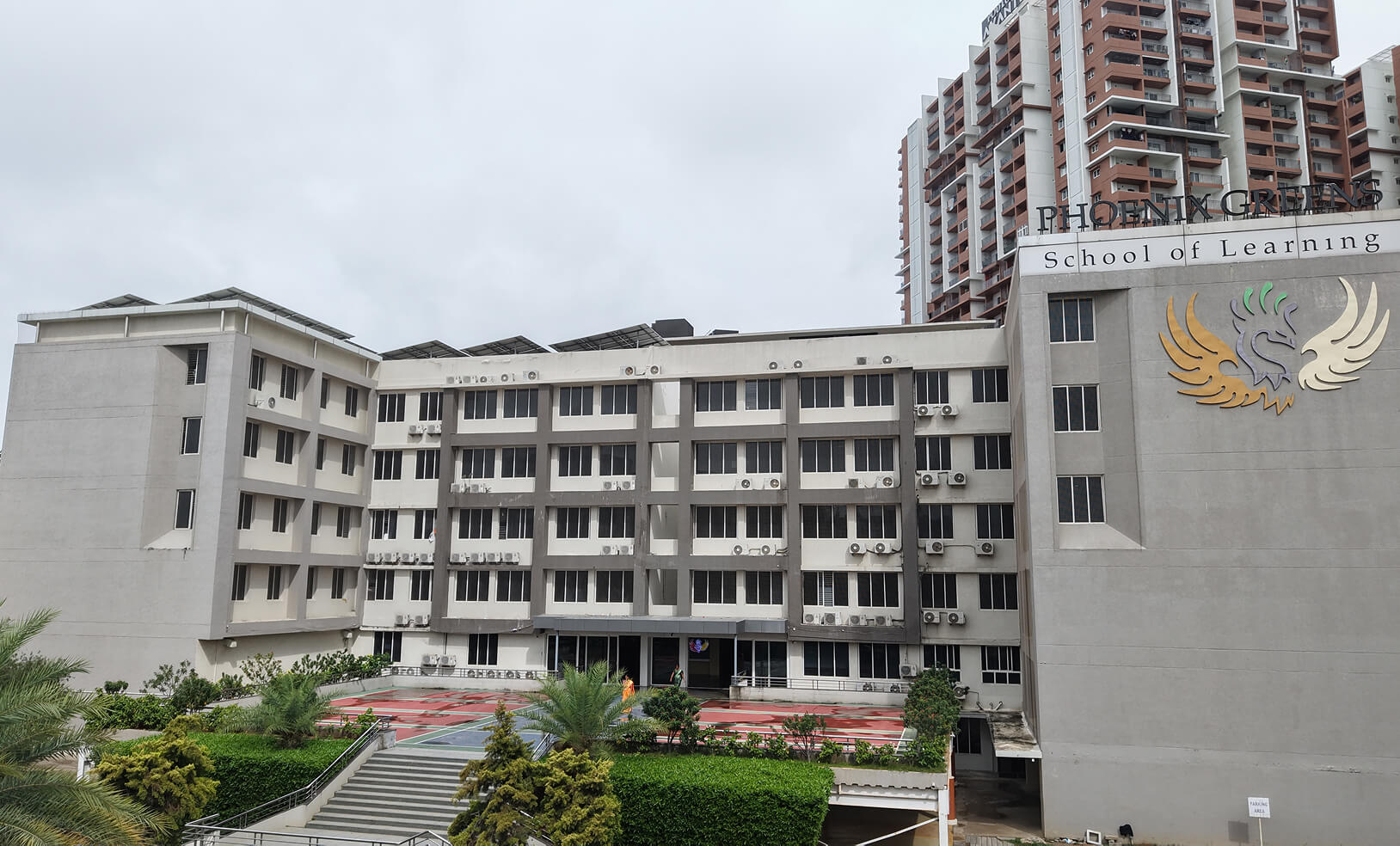
Phoenix Greens School of Learning, Kokapet is ranked #1 CBSE School in West Zone, Hyderabad (2020–24) and #1 School in Hyderabad and Telangana in national school rankings. Our students have achieved 98–99% in Class X board examinations and gone on to IIT, AIIMS, BITS Pilani, NIT Trichi, and leading international universities.
CBSE vs Other Boards: Quick Decision Guide for Hyderabad Parents
| Your Priority | Best Board |
| JEE / NEET / CUET preparation | CBSE |
| Frequent relocation across India | CBSE |
| Strong English and analytical writing | ICSE |
| State-level exams and regional career | State Board (TGBSE) |
| International university admissions (US/UK) | IB or Cambridge |
| Best combination of Indian + global readiness | CBSE + Cambridge (Phoenix Greens offers both) |
Frequently Asked Questions
Q1. Is CBSE better than ICSE for Class 10 board exams? Both boards have their strengths. CBSE Class X board exams are standardised, nationally benchmarked, and directly aligned with the competitive exam ecosystem. ICSE Class X exams tend to be more detailed and language-intensive. For students targeting JEE, NEET, or other national exams, CBSE is the more strategically aligned choice.
Q2. Can a CBSE student get admission to a foreign university? Yes. CBSE Class XII results are accepted by universities in the USA, UK, Canada, Australia, and many other countries. Strong scores, especially in relevant subjects, are recognised alongside SAT/ACT results for US admissions and alongside A Levels for UK admissions.
Q3. Is the CBSE syllabus harder or easier than the State Board? CBSE is generally considered more rigorous than most Indian state boards, particularly in Mathematics and Science. Its national standardisation means the curriculum does not vary by region, and the NCERT-based content is more extensively tested through nationally benchmarked examinations.
Q4. Why do most Hyderabad families prefer CBSE over the State Board? Families in urban Hyderabad, particularly in the IT and corporate sectors, tend to choose CBSE for three main reasons: mobility across India, alignment with national competitive examinations, and the availability of quality CBSE schools with strong faculty and infrastructure in their neighbourhoods.
Q5. Does Phoenix Greens offer both CBSE and Cambridge? Yes. Phoenix Greens School of Learning, Kokapet, offers both CBSE and Cambridge (CAIE) curricula, allowing families to choose the pathway that best fits their child’s learning style and future goals — without having to compromise or switch schools.
Q6. How can I visit Phoenix Greens and explore admissions? Visit us at Kokapet Grampanchayath Road, beside Krishna Goshala, near Tempus Apartments, Kokapet, Hyderabad. You can also reach us at +91 91343 11111 or enquire online at www.phoenixgreens.com/admissions. Admissions for 2026–27 are currently open.
Conclusion: CBSE Is Not Just a Board — It Is a Strategic Choice
In a city as dynamic and aspirational as Hyderabad, the school board your child studies under is a decision worth taking seriously. CBSE’s unparalleled alignment with India’s competitive examination system, its nationwide transferability, the quality and consistency of NCERT textbooks, and its evolution toward holistic, competency-based education make it — for most Indian families — the most strategically sound choice.
The question, then, is not whether to choose CBSE. It is where to experience CBSE at its very best.
At Phoenix Greens School of Learning, Kokapet, we are proud to answer that question every single day.
Admissions for 2026–27 are open. Enquire Now →
Phoenix Greens School of Learning | Kokapet Grampanchayath Road, beside Krishna Goshala, near Tempus Apartments, Kokapet, Rajendra Nagar Mandal, Hyderabad, Telangana – 500075 | +91 91343 11111 | frontdesk@phoenixgreens.com