
CBSE Syllabus for Class 1 to 5: Subjects, Topics & Learning Goals — A Parent’s Complete Guide
Introduction: Why the First Five Years of School Matter Most
Ask any education expert, child psychologist, or experienced teacher and they will tell you the same thing: the foundation years of school — Classes 1 to 5 — are among the most significant in a child’s entire academic life.
It is in these years that children develop their relationship with learning itself. Do they find reading joyful or frustrating? Does mathematics feel like a puzzle to be solved or an obstacle to be feared? Are they curious about the world around them, or are they already switching off? These attitudes — formed in the primary years — tend to persist all the way through secondary school and beyond.
Understanding the CBSE syllabus for Classes 1 to 5 gives parents a powerful tool: the ability to support, engage, and reinforce what their child is learning at school, every single day. You do not need to be a teacher to be an involved parent. You just need to know what your child is learning and why.
At Phoenix Greens School of Learning, Kokapet, Hyderabad, we believe deeply in parent partnership. This guide is written for you — the parent who wants to understand exactly what your child will study in each class, what the learning goals are, and how you can support their growth at home.
How the CBSE Primary Curriculum Is Structured
Under the National Education Policy (NEP) 2020, CBSE has reorganised its entire school curriculum into a 5+3+3+4 framework. Classes 1 to 5 fall across two of these four stages:
Foundational Stage (Pre-Primary to Class 2 | Ages 3–8) The first two years of formal schooling (Classes 1 and 2) are part of the Foundational Stage, which also includes three years of pre-primary education. The emphasis here is on play-based and activity-based learning, foundational literacy (reading and writing), and numeracy (basic number sense). There are no heavy textbooks, no high-stakes exams, and no rote learning pressure.
Preparatory Stage (Classes 3 to 5 | Ages 8–11) Classes 3, 4, and 5 form the Preparatory Stage. Learning here becomes more structured and subject-specific, but the spirit remains exploratory and interactive. Children begin engaging with dedicated textbooks, light formal assessments, and a broader range of subjects while still learning through stories, activities, projects, and discovery.
Together, Classes 1 to 5 form the complete primary school journey in CBSE — a journey designed to make children confident, curious, communicative, and fundamentally literate and numerate by the time they step into Class 6.
Core Subjects: Classes 1 to 5
The primary CBSE curriculum includes the following core subjects:
Subject | Classes |
English | 1 to 5 |
Hindi | 1 to 5 |
Mathematics | 1 to 5 |
Environmental Studies (EVS) | 1 to 5 |
Art Education | 1 to 5 |
Physical Education | 1 to 5 |
General Knowledge / Computer (school-specific) | 3 to 5 |
Class 1 Syllabus: The First Step into Formal Learning
Class 1 is a child’s first encounter with structured schooling. The entire approach is designed to be warm, welcoming, and activity-rich. Learning happens through songs, stories, rhymes, games, and hands-on activities. The goal is not academic pressure — it is the joy of discovery.
English — Class 1
NCERT Textbook: Marigold (Book 1)
The Class 1 English syllabus focuses on building early literacy — recognising letters, forming sounds, reading simple words, and constructing basic sentences. Children engage with short stories, illustrated poems, and picture-based exercises.
Key topics covered: – Alphabet recognition and phonics – Simple three- and four-letter words – Basic reading comprehension through illustrated stories – Oral communication — speaking in sentences – Introduction to nouns, action words (verbs), and simple grammar
Learning Goal: By the end of Class 1, children should be able to read simple sentences, write common words, understand basic grammar concepts, and communicate in spoken English with confidence.
Mathematics — Class 1
NCERT Textbook: Math Magic (Book 1)
Class 1 Mathematics is entirely concrete and visual. Children learn numbers not as abstract symbols, but as representations of real objects. Counting, comparing, grouping, and simple calculations are all taught through games and manipulatives.
Key topics covered: – Numbers 1 to 100 — counting, reading, writing – Shapes and spatial awareness — circles, squares, triangles – Addition and subtraction using objects – Simple measurements — length, weight, capacity using non-standard units – Patterns and sequences
Learning Goal: Children develop number sense, basic arithmetic ability, and the confidence to engage with mathematical thinking through real-world contexts.
Environmental Studies (EVS) — Class 1
NCERT Textbook: Integrated with English and Hindi readers at this stage
At Class 1, EVS is not taught as a formal stand-alone subject. Instead, environmental awareness is woven into English and Hindi readers through stories about families, animals, plants, and everyday experiences.
Key themes: – Family and relationships – Plants and animals in our surroundings – Food, water, and health – Festivals and community – Basic cleanliness and hygiene
Learning Goal: Children begin noticing and caring about the world around them — their family, neighbourhood, and natural environment.
Hindi — Class 1
NCERT Textbook: Rimjhim (Book 1)
Hindi at Class 1 focuses on script recognition, basic vocabulary, and oral fluency. Children learn to identify Devanagari letters, form simple words, and participate in oral storytelling.
Class 2 Syllabus: Building Blocks Get Stronger
Class 2 deepens everything introduced in Class 1. Reading becomes more fluent, mathematical thinking becomes more abstract, and children begin using language more expressively. The learning environment remains play-based but with slightly more structured expectations.
English — Class 2
NCERT Textbooks: Marigold (Book 2) + Raindrops
Children now read longer stories, write short paragraphs, and begin exploring grammar more systematically. Topics include nouns, pronouns, adjectives, verbs, prepositions, simple tenses, and punctuation.
Learning Goal: Confident reading of grade-appropriate texts; ability to write short descriptive passages; clear oral communication.
Mathematics — Class 2
NCERT Textbook: Math Magic (Book 2)
Key topics: – Numbers up to 1,000 — place value (hundreds, tens, units) – Addition and subtraction up to three digits – Introduction to multiplication as repeated addition – Measurement — length (cm, m), weight (g, kg), time (days, months, seasons) – Money — recognising notes and coins, simple transactions – Shapes, symmetry, and patterns
Learning Goal: Children develop fluency with numbers, an understanding of place value, and confidence in solving simple real-world mathematical problems.
EVS — Class 2
Key themes: Family, neighbourhood, occupations, nature, animals, transport, seasons, food and health
Children begin making simple connections between their immediate environment and broader concepts — how food grows, where water comes from, why seasons change, and what different community helpers do.
Class 3 Syllabus: The Preparatory Stage Begins
Class 3 is a significant step up. Children now have dedicated NCERT textbooks across all main subjects, including a formal EVS textbook for the first time. The Preparatory Stage has begun, and with it comes a gradual shift toward more structured academic engagement — though always through exploration and activity.
English — Class 3
NCERT Textbooks: Marigold (Book 3) + Raindrops
Key topics: – Reading comprehension — stories, poems, and dialogues – Writing — sentences, short paragraphs, simple letters – Grammar — nouns, pronouns, adjectives, verbs, tenses (present, past, future) – Vocabulary building through context – Speaking and listening activities
Learning Goal: Children read independently, write structured paragraphs, and apply basic grammar rules with growing confidence.
Mathematics — Class 3
NCERT Textbook: Math Magic (Book 3)
Key topics: – Numbers up to 9,999 — reading, writing, comparing – Addition and subtraction of 4-digit numbers – Multiplication tables (2 to 10) and multiplication of 2-digit numbers – Introduction to division as sharing equally – Fractions — halves and quarters in practical contexts – Data handling — reading simple pictographs and bar charts – Geometry — lines, angles, basic 2D shapes
Learning Goal: Children develop multiplication fluency, begin understanding fractions and data, and connect mathematical concepts to everyday situations.
Environmental Studies — Class 3
NCERT Textbook: Looking Around (Book 3)
This is where formal EVS learning truly begins. Children explore their world systematically — the living and non-living, their immediate community, and basic concepts about the earth.
Key chapters and themes: – Poonam’s Day Out — habitats and living things – The Plant Fairy — parts of a plant, photosynthesis basics – Water — sources, uses, conservation – Our Family, Our Community — relationships and roles – From Here to There — transport and maps – Eating Together — food, nutrition, culture – Weather and Seasons — observation and patterns
Learning Goal: Children develop scientific curiosity, a sense of environmental responsibility, and an understanding of their social and natural world.
Hindi — Class 3
NCERT Textbook: Rimjhim (Book 3)
Children read and write connected passages in Hindi, learn basic grammar (sangya, sarvnam, kriya), and engage with Hindi poetry and prose that reflects Indian culture and values.
Class 4 Syllabus: Curiosity Grows Deeper
By Class 4, children are confident readers and writers. Mathematics becomes more abstract and multi-step. EVS explores broader themes including India as a nation. The emphasis on thinking, reasoning, and asking questions grows.
English — Class 4
NCERT Textbook: Marigold (Book 4)
Key topics: – Reading longer prose and poetry with comprehension questions – Writing — paragraphs, descriptions, simple narratives – Grammar — tenses (all three), degrees of comparison, prepositions, conjunctions – Composition — guided and free writing tasks
Learning Goal: Children write independently on given topics with appropriate structure, grammar, and vocabulary.
Mathematics — Class 4
NCERT Textbook: Math Magic (Book 4)
Key topics: – Large numbers — up to 10,000 and beyond – Operations — all four (addition, subtraction, multiplication, division) with larger numbers – Factors and multiples – Fractions — comparing, adding, and subtracting simple fractions – Shapes — 3D shapes (cuboid, cube, cylinder, cone, sphere) – Measurement — area and perimeter of simple shapes – Time — reading clocks, calendars, calculating time intervals – Money — real-world transactions, profit/loss concepts at an introductory level
Learning Goal: Children solve multi-step mathematical problems, begin understanding geometric properties, and connect maths to practical money and measurement contexts.
Environmental Studies — Class 4
NCERT Textbook: Looking Around (Book 4)
Key chapters and themes: – Going to School — transport across India and the world – Eating Together — food diversity, nutrition, regional cuisine – The Story of Amrita — trees, environment, conservation (the Chipko Movement) – Reaching Grandmother’s House — journey, maps, India’s geography – Anita and the Honeybees — insects, interdependence, ecosystems – Changing Families — family structures, social change – The World in My Home — media, communication, technology
Learning Goal: Children build social awareness, environmental consciousness, and a beginning understanding of India’s geographical and cultural diversity.
Class 5 Syllabus: The Bridge to Middle School
Class 5 is the culminating year of primary school — a bridge between the nurturing primary years and the more rigorous Middle Stage that begins in Class 6. The syllabus grows in complexity across all subjects, and children are expected to demonstrate greater independence in thinking, writing, and problem-solving.
English — Class 5
NCERT Textbook: Marigold (Book 5)
Key topics: – Reading comprehension — longer, more complex texts – Creative and descriptive writing — essays, stories, character sketches – Grammar — direct and indirect speech, active and passive voice (introductory), clauses – Vocabulary — synonyms, antonyms, idioms, proverbs – Writing letters — formal and informal formats
Learning Goal: Children write fluently and expressively, engage critically with a range of texts, and communicate effectively in spoken and written English.
Mathematics — Class 5
NCERT Textbook: Math Magic (Book 5)
Key topics: – Large number operations — multiplication and division of 4-digit numbers – Fractions — addition and subtraction of unlike fractions – Decimals — reading, writing, and simple operations – Percentage — introduction to the concept – Area and perimeter — of rectangles, squares, and irregular shapes – Angles and triangles — types and properties – Volume — introduction (using unit cubes) – Data handling — bar graphs and pie charts (reading and interpreting)
Learning Goal: Children develop mathematical reasoning, an ability to work with fractions and decimals, spatial understanding, and early data literacy.
Environmental Studies — Class 5
NCERT Textbook: Looking Around (Book 5)
Key chapters and themes: – Seeds and Seeds — plant reproduction, germination – Every Drop Counts — water conservation, the water cycle in depth – Walls Tell Stories — Indian history through architecture and monuments – Across the Wall — India’s border states, life in different regions – Blow Hot, Blow Cold — heat, temperature, climate – Up You Go — mountaineering, life at high altitude – Whose Forests? — tribal communities, deforestation, conservation – A Treat for Mosquitoes — public health, malaria, cleanliness
Learning Goal: By the end of Class 5, children have a broad, integrated understanding of science, social studies, health, and environmental issues — and they can apply this knowledge to real-world conversations and contexts.
Assessment in Classes 1 to 5: No Pressure, Just Progress
One of the most parent-reassuring aspects of CBSE’s primary curriculum is its no-board-exam, low-pressure assessment philosophy for Classes 1 to 5.
Classes 1 and 2 (Foundational Stage): No formal written exams. Assessment is entirely through continuous classroom observation, oral activities, art, storytelling, and teacher-led activities. The goal is to track development, not rank children.
Classes 3 to 5 (Preparatory Stage): A two-term structure with: – Term I — Periodic tests, activities, and oral assessments (mid-year) – Term II — Formal written tests alongside ongoing continuous assessment
All assessment in primary classes follows a continuous and comprehensive evaluation (CCE) philosophy — meaning your child is assessed on their progress over time, not on a single day’s performance.
How Phoenix Greens Brings the CBSE Primary Curriculum to Life
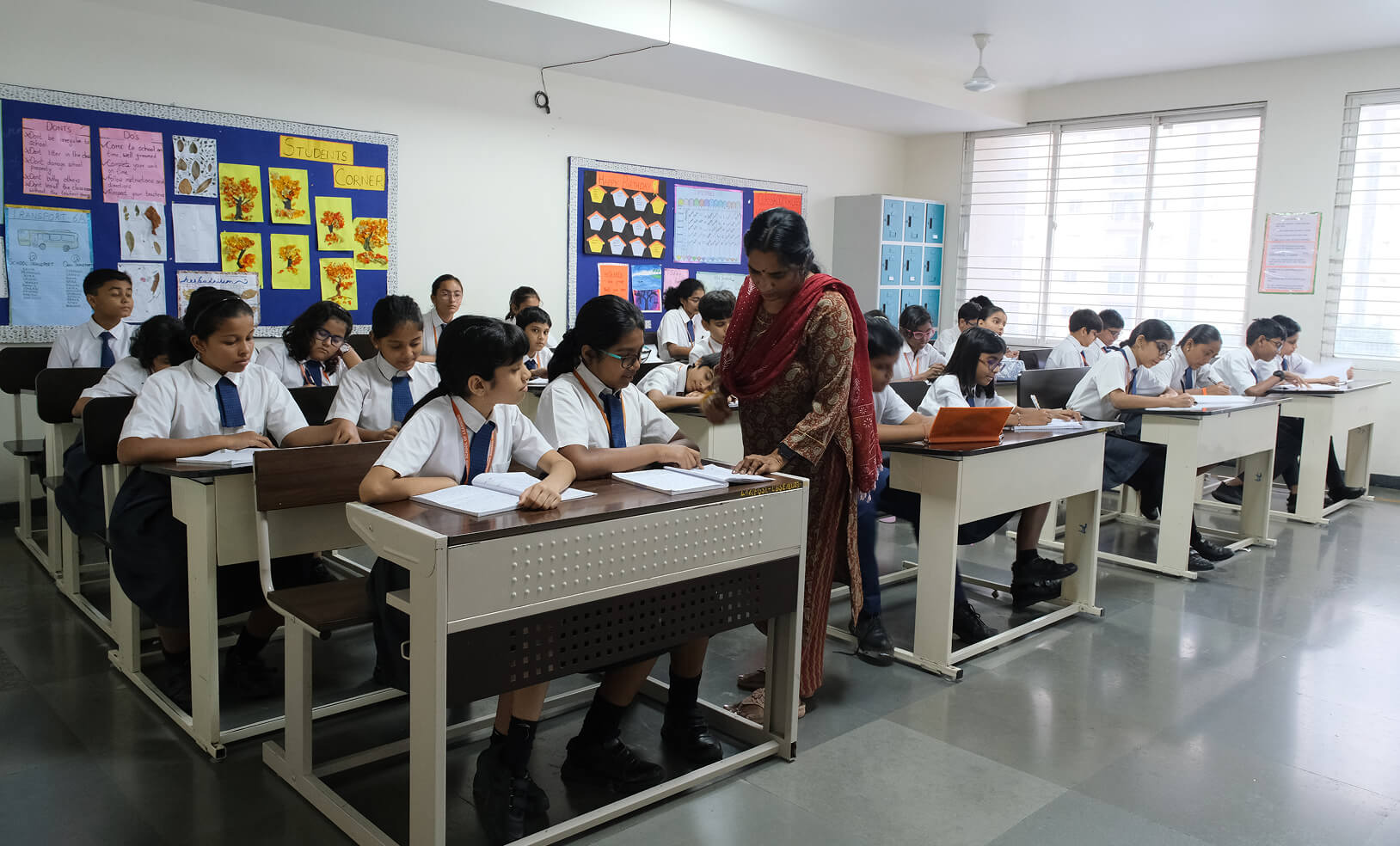
Understanding the CBSE syllabus is one thing. Experiencing it in a classroom that makes every concept come alive is another. At Phoenix Greens, Kokapet, we go far beyond textbook delivery. Our primary school programme is built on:
Activity-based classrooms where children learn through doing — science experiments, art projects, outdoor observations, storytelling circles, and collaborative games.
Smart classroom technology with interactive panels that bring concepts to life visually — whether it is understanding the water cycle through an animated simulation or practising multiplication through interactive games.
Mother-tongue-friendly teaching at the Foundational Stage, in alignment with NEP 2020’s recommendation that early learning is most effective when connected to a child’s home language.
Dedicated specialist teachers for Art, Physical Education, and Music from Class 1 — ensuring that holistic development begins from day one.
Regular parent-teacher communication that keeps you informed about your child’s progress, strengths, and the specific concepts they are working on — because an involved parent is the most powerful learning resource any child can have.
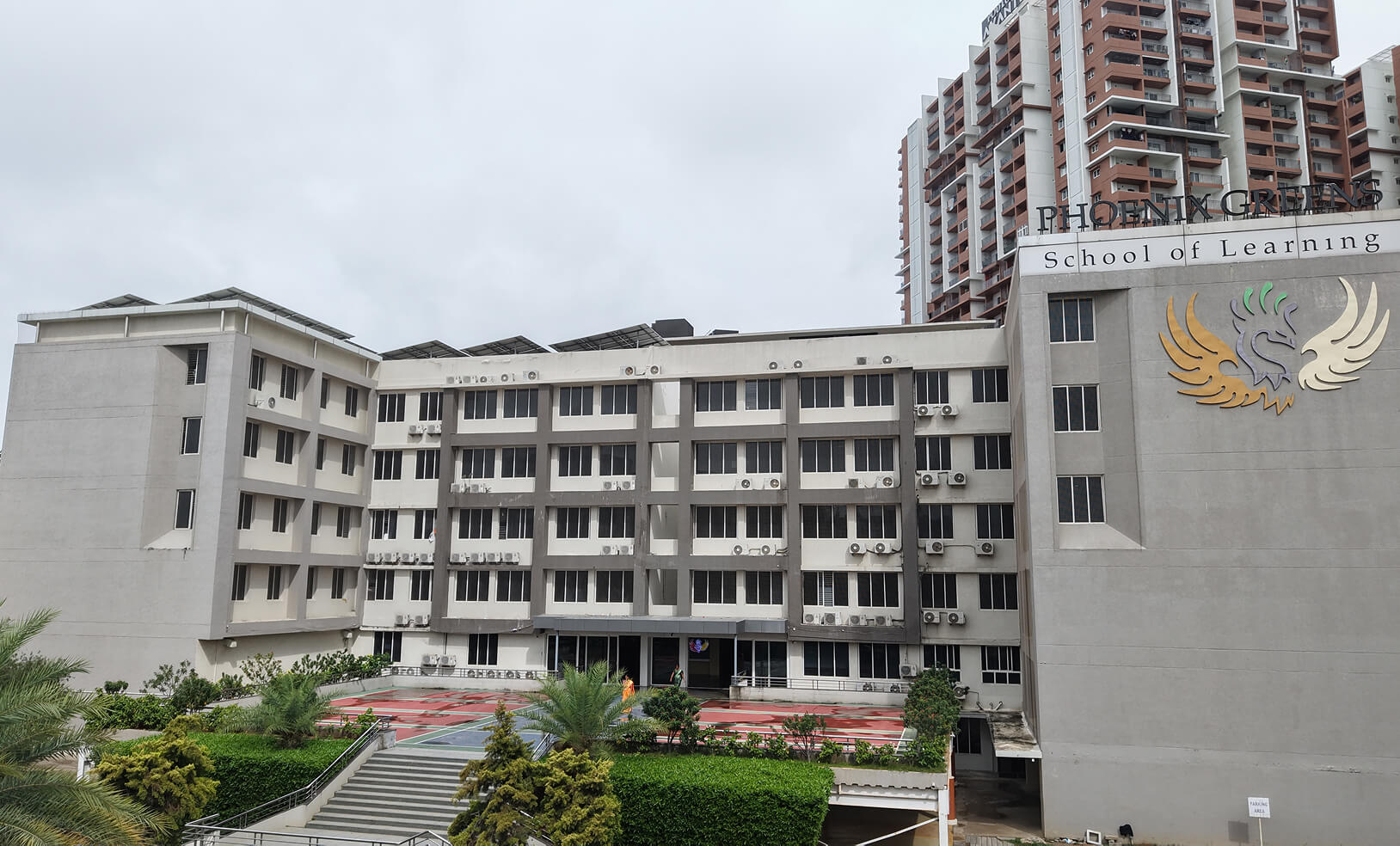
A safe, joyful campus spread across 5 acres in Kokapet, with age-appropriate play areas, a well-resourced library, and learning spaces designed to spark curiosity at every corner.
Frequently Asked Questions
Q1. Does Class 1 have any formal exams at Phoenix Greens? No. Classes 1 and 2 follow CBSE’s Foundational Stage philosophy of continuous, activity-based assessment. There are no written examinations. Your child is assessed through classroom observation, oral activities, and teacher interaction throughout the year.
Q2. What are the NCERT textbooks for Classes 1 to 5? The key NCERT textbooks across Classes 1–5 are: Marigold (English), Rimjhim (Hindi), Math Magic (Mathematics), Looking Around (EVS for Classes 3–5), and Raindrops (supplementary English reader). Phoenix Greens follows these textbooks as the primary resource, supplemented by enrichment materials.
Q3. Is EVS a separate subject from Class 1? At Classes 1 and 2, EVS themes are integrated into English and Hindi readers through stories and activities. From Class 3 onwards, EVS is taught as a dedicated subject using the NCERT Looking Around textbook series.
Q4. How much homework should a Class 1 or 2 child get? CBSE and NEP 2020 guidelines recommend minimal homework at the Foundational Stage. Phoenix Greens follows this philosophy — homework at Classes 1 and 2 is light, purposeful, and designed to reinforce classroom learning without stressing children at home.
Q5. When does my child begin learning a second language? Hindi is taught from Class 1 as a second language alongside English. Schools may also introduce a third language (Telugu/Sanskrit) from Class 3 onwards, in line with NEP 2020’s multilingualism framework. Phoenix Greens offers this integrated language programme.
Q6. How can I get my child admitted to Phoenix Greens for Class 1? Please visit www.phoenixgreens.com/admissions or call +91 91343 11111. Our admissions team will guide you through the process. Admissions for 2026–27 are currently open, and we encourage early enquiries to secure your child’s place.
Conclusion: The First Five Years Are the Foundation for Everything
The CBSE syllabus for Classes 1 to 5 is not a list of topics to be memorised and tested. It is a carefully designed developmental journey — one that builds literacy, numeracy, curiosity, environmental awareness, and social values in an age-appropriate, joyful, and progressive way.
As a parent, knowing what your child is learning — and why — transforms you from an observer into an active partner in their education. And choosing a school that delivers this curriculum with genuine expertise, care, and creativity makes all the difference.
At Phoenix Greens School of Learning, Kokapet, Hyderabad, we are honoured to be that school for hundreds of Hyderabad families — and we look forward to welcoming yours.
Admissions for 2026–27 are open. Enquire Now →
Phoenix Greens School of Learning | Kokapet Grampanchayath Road, beside Krishna Goshala, near Tempus Apartments, Kokapet, Rajendra Nagar Mandal, Hyderabad, Telangana – 500075 | +91 91343 11111 | frontdesk@phoenixgreens.com