
CBSE Syllabus for Class 9 & 10: What Students and Parents in Hyderabad Need to Know
CBSE Syllabus for Class 9 & 10: What Students and Parents in Hyderabad Need to Know
There is a particular kind of quiet that settles over a household when a child enters Class 9. The playfulness of middle school gives way to something more purposeful, more pressured. Suddenly, the conversations at home shift — from “how was your day?” to “how is the preparation going?” and “which stream are you thinking about?”
Class 9 and 10 together form the secondary stage of CBSE schooling, and they carry a weight that earlier classes do not. Class 10 ends with the Board examination — the first high-stakes, externally assessed milestone in a student’s academic life. Everything in Class 9 is preparation for that moment, and everything in Class 10 builds toward it.
For parents in Hyderabad navigating this stage, the challenge is not just managing anxiety — it is understanding what the curriculum actually demands, subject by subject, year by year. This guide breaks it down clearly.
What Makes Classes 9 and 10 Different from What Came Before
The shift from Class 8 to Class 9 is the steepest academic jump in the CBSE journey. It is not just that the syllabus gets harder — it is that the nature of the learning changes. In middle school, concepts are introduced with some room for exploration. In Class 9, the expectation is precision: the right formula, the correct method, the well-structured answer.
Several things change at once. The syllabus in every core subject expands significantly. Internal assessments begin to count toward the final grade in a formal, structured way. And the shadow of the Class 10 Board examination means that even daily classwork carries a different kind of stakes.
At the same time, Class 9 and 10 are also when many students discover what they are genuinely good at — and what they find genuinely interesting. The subject depth at this level is enough to spark real curiosity in a way that the middle school curriculum, by design, cannot. For the students who engage with that curiosity rather than just trying to survive the syllabus, this stage becomes one of the most rewarding in their school life.
How Assessment Works in Classes 9 and 10
Understanding the assessment structure is one of the most practically useful things a parent can do. The CBSE system at this stage has two components: internal assessment and the Board examination.
Internal assessment accounts for 20 marks in each subject and includes periodic tests conducted by the school, subject enrichment activities, and portfolio work. These 20 marks are entirely within the school’s control to award, which means that a student who performs well in class throughout the year has a genuine head start.
The Board examination accounts for the remaining 80 marks and is conducted at the end of Class 10. It is set and marked by CBSE centrally — the school has no role in setting the paper or assessing the responses. This is the examination that appears on mark sheets and is used for senior school admissions.
Class 9 does not have a CBSE Board examination. It has school-conducted final examinations, which are important because Class 9 performance determines promotion to Class 10 and, in many schools, shapes how seriously the student approaches Class 10 from the very beginning of the year.
Subject-wise: What Your Child Studies in Classes 9 and 10
Mathematics
The CBSE Mathematics syllabus for Classes 9 and 10 is structured around six core areas: Number Systems, Algebra, Coordinate Geometry, Geometry, Mensuration, and Statistics and Probability.
In Class 9, students encounter real numbers in depth, begin working with polynomials, get their first serious introduction to coordinate geometry, and study Euclidean geometry through formal proofs. The proof-writing element is new and often challenging — it requires students to think logically rather than just compute.
Class 10 builds directly on this. Polynomials lead into quadratic equations. Triangles and circles in geometry become more complex. Statistics moves from basic averages to median, mode, and the use of cumulative frequency curves. Trigonometry, introduced in Class 10, is one of the most significant new topics — and one that students either find intuitive or find bewildering, depending on how it is taught.
The Board examination maths paper tests both procedural accuracy and conceptual understanding. Students who have only memorised formulas without understanding the reasoning behind them tend to struggle with the application-based questions that now feature prominently.
Science
Science in Classes 9 and 10 is formally divided into three disciplines: Physics, Chemistry, and Biology. Each has its own character, its own demands, and its own reward.
In Physics, Class 9 introduces motion, force, work, energy, and sound — topics that build the foundation for all future Physics study. Class 10 covers light (reflection and refraction), electricity, and magnetic effects of current. These topics require both mathematical ability and physical intuition, and the combination makes Physics one of the subjects where conceptual clarity matters most.
In Chemistry, Class 9 begins with matter and its properties, moves through atoms and molecules, and introduces the structure of the atom. Class 10 covers chemical reactions, acids and bases, metals and non-metals, carbon compounds, and the periodic table. The volume of content in Class 10 Chemistry is significant, and students who try to memorise reactions without understanding patterns tend to find it overwhelming.
In Biology, Class 9 introduces cells, tissues, and fundamental life processes — nutrition, respiration, transportation, and excretion. Class 10 covers reproduction, heredity and evolution, ecosystems, and environmental management. The Class 10 Biology syllabus is conceptually rich and, for many students, the most interesting part of the Science curriculum.
Practical work is a formal part of the Science curriculum at this level. The internal assessment includes a practical examination, and students are expected to demonstrate experimental skills — not just theoretical knowledge.
Social Science
Social Science at this level is structured around four textbooks: History (India and the Contemporary World), Geography (Contemporary India), Political Science (Democratic Politics), and Economics (Understanding Economic Development).
Class 9 History focuses on the French Revolution, socialism and the Russian Revolution, Nazism and the rise of Hitler, forest societies, and pastoralists — a sweep of modern world history that connects past events to present realities. Class 10 moves to the rise of nationalism in Europe and India, the age of industrialisation, and print culture and the modern world.
Geography in Class 9 covers India’s size, location, physical features, drainage systems, climate, and natural vegetation. Class 10 focuses on resources, agriculture, water, minerals, manufacturing, and life lines of the national economy. It is a subject that benefits from connecting classroom learning to the real world — the map work element, in particular, rewards students who engage with it actively.
Political Science and Economics become substantive and analytical at this level. Students are expected not just to recall facts but to explain how democratic systems work, why economic development is uneven, and what the role of money, credit, and globalisation is in shaping livelihoods. The writing demands in Social Science are high — the ability to structure a coherent, well-supported answer is tested directly in the Board examination.
English
The CBSE English syllabus for Classes 9 and 10 is based on two textbooks — a literature reader (Beehive in Class 9, First Flight in Class 10) and a supplementary reader (Moments in Class 9, Footprints Without Feet in Class 10) — alongside grammar and writing components.
The literature texts include prose, poetry, and plays from a wide range of authors — Indian and international. Students are expected to read closely, understand themes, and respond analytically rather than just retelling plots. The grammar section covers a range of structures that are tested through gap-fills, transformation exercises, and passage-editing tasks.
The writing section of the English paper includes formal letters, analytical paragraphs, and notices or advertisements. These are structured tasks with specific conventions, and students who practise them regularly perform significantly better than those who encounter them only in the examination.
English is often the subject where students can most reliably gain marks if they prepare systematically. It rewards consistent reading, careful grammar practice, and structured writing — all habits that are worth building early in Class 9.
Hindi (Second Language)
Hindi in Classes 9 and 10 is based on two course books — Kshitiz and Kritika in Class 9, Kshitij and Kritika in Class 10 — along with grammar and writing components. For students in Hyderabad who use Telugu at home and English at school, Hindi can feel like the most challenging subject to prepare for. The key is consistent engagement through the year rather than intensive revision in the final weeks.
The writing component — which includes essays, letters, and paragraph-length responses — carries significant marks and is entirely within a student’s ability to prepare for with practice. Many students underestimate the Hindi paper until it is too late to address the gap.
The Difference Between Class 9 and Class 10: What Parents Should Know
Class 9 is foundation-building. It introduces the full scope of the secondary syllabus and establishes the conceptual base that Class 10 will build on. Students who treat Class 9 seriously — who keep up with the syllabus week by week, who clarify doubts as they arise, and who take their school examinations genuinely seriously — find Class 10 significantly more manageable.
Class 10 is consolidation and performance. The first half of the year deepens and extends what was covered in Class 9. The second half is increasingly shaped by Board examination preparation — revision, mock papers, time management under exam conditions. The rhythm of Class 10 is fundamentally different from any year that came before it.
One thing worth noting for Hyderabad families specifically: the competition for seats in strong Class 11 programmes — whether at Phoenix Greens or at other schools in the area — is based on Class 10 marks. The cut-offs for Science and Commerce streams at reputed schools can be high. This is not a reason to create pressure, but it is a reason to plan ahead and ensure that Class 9 is treated as seriously as Class 10.
Practical Ways Parents Can Support Their Child Through This Stage
The most valuable thing a parent can provide during Classes 9 and 10 is a calm, organised home environment. Exam pressure is real, and a household that treats it with steady seriousness rather than panic or dismissal makes a genuine difference to how a student performs.
Beyond the environment, a few practical things consistently help. Knowing the exam schedule well in advance — and helping your child build a realistic revision timetable — is more useful than telling them to study harder. Encouraging them to attempt past papers under timed conditions from at least three months before the Board examinations is one of the highest-value things they can do.
Be alert to the subjects where your child is weakest, and address those early. Many students spend their revision time on subjects they already do well in — it is comfortable, and it feels productive. The marks, however, are usually recovered in the weaker subjects.
Finally, sleep and physical activity are not optional extras during this period. The research on exam performance consistently shows that students who sleep adequately and exercise regularly outperform equally well-prepared students who do not. It is worth treating this as seriously as the study schedule itself.
How Phoenix Greens Prepares Students for the Class 10 Board Examination
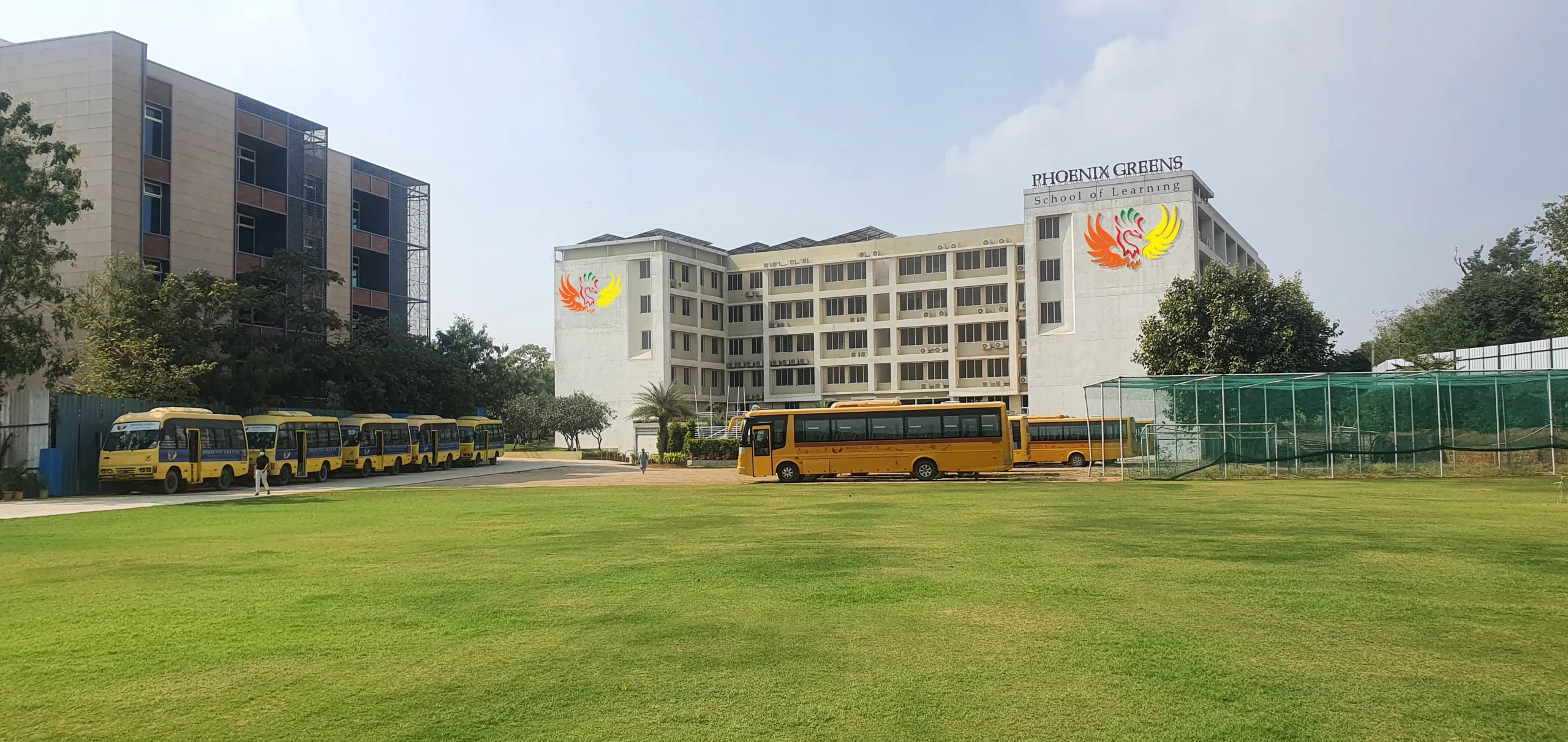
At Phoenix Greens School of Learning in Kokapet, Hyderabad, Class 9 and 10 are approached as a two-year programme rather than two separate years. The curriculum planning ensures that what students encounter in Class 9 directly prepares them for what they will need to do in Class 10 — not just in terms of content, but in terms of the thinking and writing skills that the Board examination rewards.
The school’s dual CBSE and Cambridge curriculum brings a particular advantage at this stage. Cambridge-trained teachers are accustomed to teaching for deep understanding rather than surface recall — an approach that pays dividends in the application-based questions that now feature prominently in CBSE Board papers.
Regular mock examinations, structured revision programmes, and individual academic mentoring are all part of how Phoenix Greens supports students through this critical period. For families in Narsingi, Rajendra Nagar, and the surrounding areas, this combination of academic rigour and pastoral support is what sets the school’s Class 9–10 programme apart.
The Bottom Line
Class 9 and 10 are the years that shape a student’s academic trajectory more than any others in school. The CBSE curriculum at this stage is rigorous, comprehensive, and — when well taught — genuinely engaging. The Board examination is not a wall; it is a milestone. And like every milestone, it is navigated best with preparation, clarity, and the right support.
If you would like to understand how Phoenix Greens approaches Classes 9 and 10, or if you are considering admissions for your child at the secondary stage, we would be happy to have that conversation. Reach out to our admissions team — we are glad to walk you through what the programme looks like in practice.