
Cambridge Curriculum vs Other Boards: Why It’s the Global Choice for Ambitious Families in Hyderabad
Introduction: The Board Decision That Shapes the World Your Child Enters
Walk through any residential neighbourhood in Kokapet, Narsingi, Financial District, or Manikonda today, and you will hear parents debate the school board question at every gathering. CBSE or Cambridge? IB or ICSE? State Board or international? The options have multiplied, the stakes feel high, and the terminology alone can leave even the most informed parent overwhelmed.
But here is what the best conversations about school boards always come back to: it is not about which board is “best.” It is about which board is best for your child — their learning style, their personality, your family’s future plans, and the kind of adult you want to help them become.
At Phoenix Greens School of Learning, Kokapet, Hyderabad, we offer both the Cambridge (CAIE) and CBSE curricula under one roof, which means we have no vested interest in steering you toward one over the other. What we do have is a deep, practitioner-level understanding of what makes the Cambridge curriculum so uniquely powerful — and who it is truly designed to serve.
This guide offers a clear, honest, and comprehensive comparison of the Cambridge curriculum against every major board in India, so you can walk away with the clarity you need.
The Boards at a Glance: Who Governs What
Before comparing, it helps to understand who sits behind each board.
Cambridge (CAIE) — Cambridge Assessment International Education Administered by a department of the University of Cambridge, CAIE is one of the world’s oldest and most trusted international education organisations. It serves nearly one million students in over 10,000 schools across 160 countries. The Cambridge pathway runs from Primary (age 5) through to A Levels (age 19) and is built on a consistent philosophy of inquiry, analysis, and critical thinking.
CBSE — Central Board of Secondary Education India’s largest national board, governed by the Government of India. Uses NCERT textbooks. Directly aligned with national competitive examinations like JEE, NEET, and CUET. Present in all 28 Indian states and abroad.
ICSE — Indian Certificate of Secondary Education A private national board governed by the Council for the Indian School Certificate Examinations (CISCE). Known for its language-rich, comprehensive syllabus with strong emphasis on English literacy, analytical writing, and balanced subject coverage.
IB — International Baccalaureate A globally recognised programme headquartered in Geneva, offering four sub-programmes: Primary Years (PYP), Middle Years (MYP), Diploma (DP), and Career-related (CP). Known for its holistic, inquiry-based, interdisciplinary philosophy. India currently has approximately 276 IB-affiliated schools.
State Board (Telangana — TGBSE) Governed by the Telangana State Board of Secondary Education. Curriculum tailored to regional needs, language, and state-level university entrance examinations (TS EAMCET). Most affordable option, with regional language instruction.
Comprehensive Comparison: Cambridge vs All Major Boards
| Factor | Cambridge (CAIE) | CBSE | ICSE | IB | State Board |
| Governing Body | University of Cambridge | Govt. of India | CISCE (Private) | IBO, Geneva | State Government |
| Global Recognition | Excellent — 160+ countries | Good | Moderate | Excellent | Limited |
| Indian University Acceptance | Yes — select institutions | Yes — all | Yes — most | Yes — select | State-level |
| Aligned with JEE/NEET | No | Yes — directly | Partially | No | Partially |
| Curriculum Philosophy | Inquiry, analysis, independent thinking | Structured, concept-based | Comprehensive, language-strong | Inquiry, interdisciplinary | Regional, structured |
| Subject Flexibility | Very High — 70+ subjects | Moderate (stream-based) | Moderate | High (6 groups) | Low |
| Assessment Style | Mixed — written, coursework, practical, oral | Primarily annual board exams | Written + project-based | Continuous + external | Annual exams |
| Grading | A* to G (IGCSE); A* to E (A Level) | CGPA / percentage | Percentage (1-9 scale) | Points system (1–45) | Percentage |
| Transferability | International | National (India-wide) | National (limited) | International | State-only |
| Fee Structure | Premium | Affordable–moderate | Moderate | Very high | Very affordable |
| Best for | Global universities, critical thinkers | JEE, NEET, Indian exams | Language, arts, balanced | Global, interdisciplinary | Local career goals |
Why the Cambridge Curriculum Stands Apart: 8 Defining Advantages
1. A Qualification Trusted by the World’s Best Universities
The Cambridge IGCSE and A Level qualifications are recognised by universities in over 130 countries, including the United Kingdom, United States, Canada, Australia, Singapore, Germany, the Netherlands, and beyond. For students applying to institutions like the University of Oxford, University of Cambridge, Imperial College London, MIT, University of Toronto, NUS Singapore, or the University of Melbourne, A Level grades are among the most respected and well-understood entry qualifications in the world.
Unlike CBSE or ICSE, where Indian admissions officers are the primary audience, Cambridge qualifications are designed for a truly global audience. An A Level from Phoenix Greens, Kokapet carries precisely the same international weight as one from a school in London or Singapore — because the marking, moderation, and grading are all handled by Cambridge International to a consistent global standard.
2. Intellectual Depth Over Information Volume
The Cambridge curriculum is built on a fundamental belief: it is better for a student to understand a smaller number of ideas deeply than to memorise a large number of facts superficially. This philosophy shapes everything — from how questions are designed to how teachers are trained to how students are expected to engage with material.
In a Cambridge classroom, students are not asked to reproduce textbook definitions. They are asked to evaluate arguments, weigh evidence, apply concepts to unfamiliar scenarios, and construct well-reasoned responses. This is exactly the kind of intellectual rigour that top universities worldwide look for — and that employers in every field increasingly demand.
For curious, analytical students who enjoy asking “why” more than memorising “what,” the Cambridge curriculum is an ideal home.
3. Unmatched Flexibility in Subject Choice
Cambridge IGCSE offers over 70 subjects across six groups — Languages, Humanities, Sciences, Mathematics, Creative Arts, and Technical subjects. Students typically study 6 to 9 subjects, but the combinations are almost limitless. A student can study Physics and Art History. Another can combine Economics with Computer Science and a second foreign language. Passions are not sacrificed to predetermined “streams.”
This flexibility continues at A Level, where students choose just 3 to 4 subjects — but at extraordinary depth. By the time a Cambridge A Level student completes their studies, they have engaged with their chosen subjects at a level comparable to first-year undergraduate study at many universities.
By contrast, CBSE and ICSE operate within fixed Science, Commerce, and Humanities streams with limited cross-stream flexibility, and the IB, while flexible, requires all students to study a prescribed combination of six groups with additional core components. Cambridge offers the most genuine choice of any major curriculum.
4. Multiple Assessment Modes — No Single High-Stakes Day
One of the most significant differences between Cambridge and India’s national boards is in assessment design. CBSE and ICSE students’ fates are largely determined by annual written board examinations. Cambridge distributes assessment across multiple modes:
- Written papers (structured questions, essays, case studies, data analysis)
- Coursework and research projects (internally assessed, externally moderated)
- Practical examinations (science labs, art portfolios)
- Oral and listening assessments (language subjects)
This diversity means students are assessed on the full range of their abilities — not just their performance on a single stressful morning. A student who is an exceptional researcher but a moderate exam-taker has genuine pathways to demonstrate their capability. A student with outstanding practical science skills is rewarded in a way that a purely written exam could never capture.
5. Builds Genuine University-Ready Skills
Ask any Cambridge graduate what the curriculum prepared them for, and they will rarely say “exams.” They will say: research skills, the ability to construct an argument, the confidence to challenge ideas respectfully, comfort with ambiguity and complexity, and the habit of self-directed study.
These are precisely the skills that differentiate students in their first year at university — a context where no one dictates the pace, where ideas are contested not just conveyed, and where intellectual initiative is rewarded above rote performance.
Compared to CBSE, where the structure of board exams encourages syllabus-coverage and answer-pattern familiarity, Cambridge’s open-ended assessment style produces students who are genuinely independent learners — an attribute that becomes increasingly valuable as students progress through higher education and into professional life.
6. A Spiral Curriculum That Builds on Itself
Cambridge uses what educational researchers call a “spiral curriculum” — a design principle where concepts are introduced at the Primary stage, revisited and deepened at the Lower Secondary stage, and then explored in full complexity at the IGCSE and A Level stages.
This means there is no jarring jump from “easy” to “hard.” Instead, every stage prepares students naturally for the next. A student who has been asking questions and constructing arguments since Stage 1 of Cambridge Primary arrives at IGCSE with the intellectual habits already embedded. The academic journey is coherent, progressive, and cumulative.
7. Globally Benchmarked — Not Locally Graded
Cambridge Checkpoint assessments (at Primary Stage 6 and Lower Secondary Stage 9) are internationally benchmarked — meaning your child’s results are compared against a global peer group, not just their classmates or their school cohort. This gives parents an objective, externally validated view of where their child stands academically at each stage of their education.
This transparency builds trust and informs decisions. If a Cambridge Checkpoint report shows a particular strength in Mathematics or a need for development in written English, parents and teachers can act on that information with precision — long before high-stakes examinations approach.
8. Culturally Inclusive and Globally Aware
The Cambridge curriculum is explicitly designed to be culturally inclusive — to avoid the cultural bias that can be embedded in nationally developed curricula. Science experiments, case studies in Economics, literary texts in English, and examples in Geography are drawn from diverse global contexts, not just one country’s experience.
This global awareness is not incidental — it is structural. It means Cambridge students develop a breadth of worldview and an understanding of cultural diversity that is genuinely preparation for life and work in an interconnected world. This is why international companies and global universities so consistently value Cambridge-educated graduates.
When the Cambridge Curriculum May Not Be the Right Choice
Intellectual honesty requires saying this clearly: Cambridge is not for every student. Here is when another board may be a better fit:
Choose CBSE if: Your child’s definitive goal is to crack JEE, NEET, or CUET and pursue undergraduate studies at Indian institutions like IIT, AIIMS, or NIT. The CBSE-NCERT alignment with these examinations is direct and irreplaceable. Phoenix Greens’ CBSE programme is equally strong.
Choose ICSE if: Your child has exceptional literary and analytical writing abilities and is targeting arts, journalism, law, or humanities pathways within India’s private university ecosystem.
Choose IB if: Your family has a strong preference for a purely inquiry-based, interdisciplinary philosophy across all subjects, and budget is not a significant constraint. IB’s holistic framework is philosophically compelling, though it demands a significant commitment from both students and families.
Choose State Board if: Your family is deeply rooted in Telangana, your child is preparing for TS EAMCET or state-level government examinations, and affordability is an important consideration.
Choose Cambridge if: Your child is curious, self-motivated, and enjoys thinking rather than just memorising. If your family’s educational horizon includes global universities, international careers, or frequent mobility, Cambridge is your strongest choice. And if you want the flexibility of outstanding subject choice alongside internationally respected qualifications, there is no better curriculum.
Cambridge in Hyderabad: The Phoenix Greens Advantage
Hyderabad’s Financial District and western zones — Kokapet, Narsingi, Gachibowli, Manikonda, and Rajendra Nagar — are home to an increasingly international professional community. Parents working in global technology firms, pharmaceutical companies, and consulting organisations understand that the world their children will enter is not local — it is global. And they are choosing their children’s education accordingly.
Phoenix Greens School of Learning, Kokapet, is one of Hyderabad’s most respected Cambridge-affiliated institutions. We deliver the full Cambridge pathway — from Cambridge Primary through to IGCSE and A Levels — with:
Cambridge-trained faculty who teach the inquiry-based Cambridge methodology with genuine expertise and passion, not as a superficial veneer over conventional teaching styles.
Dedicated Science Practical Facilities — essential for Cambridge assessment, where practical examinations in Physics, Chemistry, and Biology carry significant marks. Our laboratories are equipped to the full standard required.
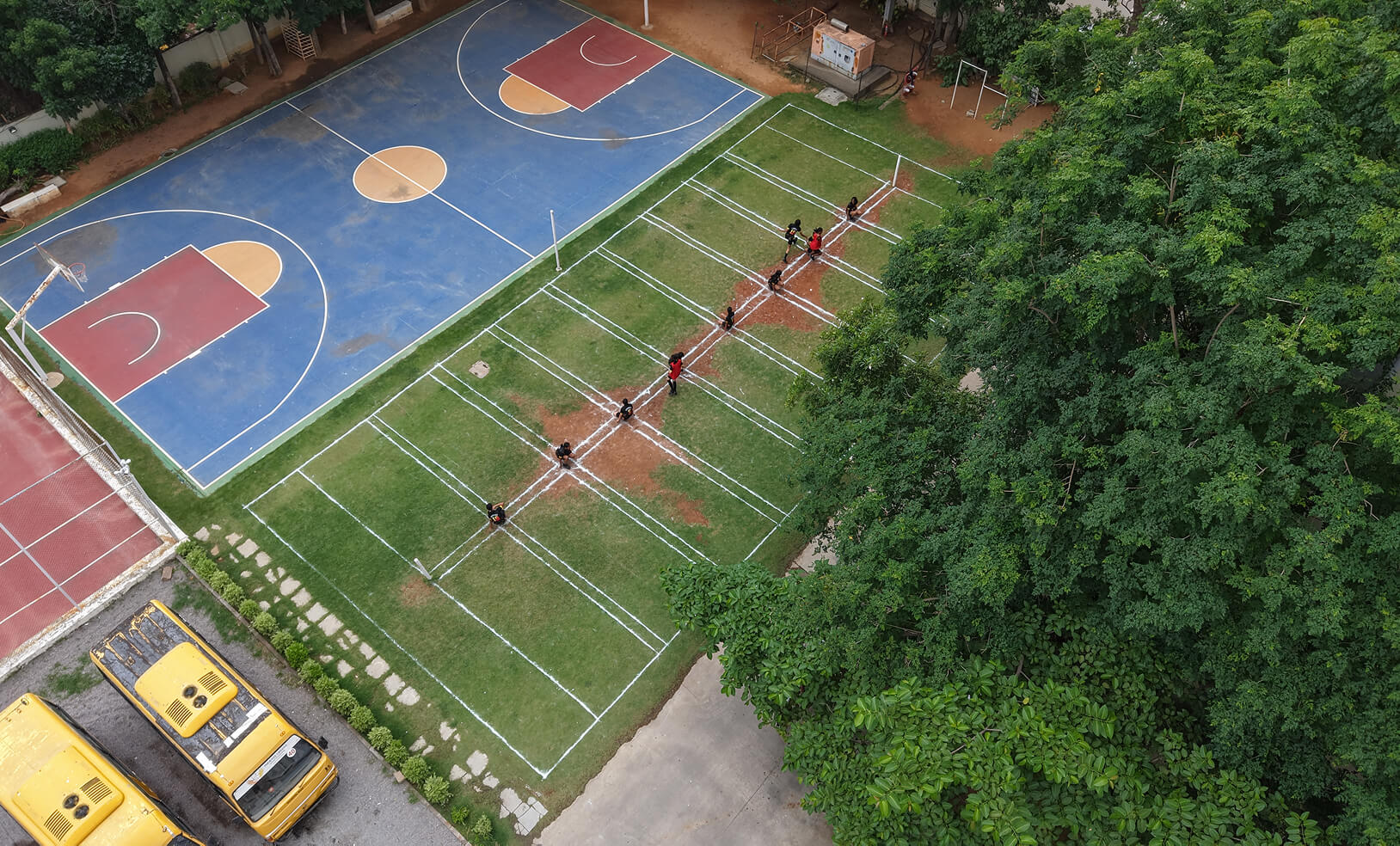
A 5-acre future-ready campus in Kokapet with smart classrooms, a 100-seater AV room, a computer lab with 45 active systems, a well-stocked library, and generous outdoor spaces — everything needed to deliver the Cambridge experience in full.
Global Perspectives integration — one of Cambridge’s most distinctive subjects, taught by teachers who understand how to help Hyderabad students engage meaningfully with global issues while staying connected to their Indian roots.
Outstanding alumni outcomes — our Cambridge students have earned places at BITS Pilani (Goa), Manipal Institute of Technology, Christ College Bangalore, Shiv Nadar University Delhi, the University of Texas at Dallas, and Mahindra University, among others.
Cambridge vs Other Boards: A Quick Decision Guide for Hyderabad Parents
| Your Priority | Best Board |
| Global university admissions (UK, US, Australia, Singapore) | Cambridge A Levels |
| JEE / NEET / CUET / Indian competitive exams | CBSE |
| Deep English literacy and balanced Indian education | ICSE |
| Purely inquiry-based, interdisciplinary learning | IB |
| State-level exams and local career goals | State Board (TGBSE) |
| World-class education with Indian and global options | Cambridge + CBSE (Phoenix Greens offers both) |
Frequently Asked Questions
Q1. Is Cambridge harder than CBSE? Cambridge and CBSE are different in nature rather than simply harder or easier. Cambridge emphasises analysis, independent thinking, and multi-modal assessment, which can feel unfamiliar to students accustomed to textbook-based learning. CBSE is more structured and exam-focused, which suits students preparing for India’s national entrance examinations. Neither is universally “harder” — it depends entirely on a student’s learning style and strengths.
Q2. Do Indian universities accept Cambridge A Level results? Yes, increasingly. Universities such as BITS Pilani, Manipal University, Ashoka University, Shiv Nadar University, FLAME University, and many private and deemed universities accept Cambridge A Level results for undergraduate admissions. Students planning for central universities or IITs via JEE will need to supplement Cambridge preparation with focused NCERT-based coaching.
Q3. Can a student switch from CBSE to Cambridge mid-school? Transitions are most manageable in the earlier years — up to Grade 6 or 7 — with appropriate bridging support. From Grade 8 onwards, the syllabuses diverge significantly, making a switch more complex. Phoenix Greens’ counselling team provides honest guidance to families considering a mid-school transition.
Q4. Why does Phoenix Greens offer both CBSE and Cambridge? Because families in Hyderabad have genuinely diverse needs. Some children are destined for IIT; others are bound for LSE or the University of Toronto. Both pathways are excellent when delivered well — and Phoenix Greens delivers both with equal commitment and expertise. No family should have to choose a school based on curriculum limitations.
Q5. What is the Cambridge Primary Checkpoint and should my child sit it? The Cambridge Primary Checkpoint is an internationally benchmarked assessment typically taken at the end of Stage 6 (approximately Grade 5 or 6) in English, Mathematics, and Science. It is not a high-stakes pass/fail examination — it is a diagnostic tool that gives parents and teachers objective, internationally benchmarked feedback on a child’s progress. Phoenix Greens uses Checkpoint results to inform teaching plans for every student.
Q6. How do I explore Cambridge admissions at Phoenix Greens? Visit www.phoenixgreens.com/admissions or call us at +91 91343 11111. Our admissions and academic counselling team will walk you through the Cambridge pathway in detail and help you assess whether it is the right fit for your child. Admissions for 2026–27 are currently open.
Conclusion: Cambridge Is Not Just a Curriculum — It Is a Philosophy for the Future
In a world where universities, employers, and societies are increasingly looking for individuals who can think independently, communicate persuasively, collaborate across cultures, and adapt to change, the Cambridge curriculum is not a luxury — it is a strategic investment.
It develops students who are ready not just for examinations, but for the complexity and opportunity of a genuinely global future. It builds young people who ask better questions, construct more nuanced arguments, and engage with the world with confidence and intellectual courage.
For families in Hyderabad who see that future clearly, Phoenix Greens School of Learning, Kokapet, is the place where the Cambridge journey begins.
Admissions for 2026–27 are open. Enquire Now →
Phoenix Greens School of Learning | Kokapet Grampanchayath Road, beside Krishna Goshala, near Tempus Apartments, Kokapet, Rajendra Nagar Mandal, Hyderabad, Telangana – 500075 | +91 91343 11111 | frontdesk@phoenixgreens.com