
What Is the Cambridge Syllabus? A Complete Guide for Parents & Students in Hyderabad
Introduction: Why Parents in Hyderabad Are Choosing the Cambridge Pathway
If you have been researching schools in Kokapet, Narsingi, Rajendra Nagar, or Manikonda, you have almost certainly come across the term Cambridge curriculum. Perhaps a neighbour mentioned it, or your child’s future career aspirations — a course abroad, a global profession — made you wonder if the traditional Indian board system alone would be enough.
The Cambridge curriculum, developed by Cambridge Assessment International Education (CAIE), is one of the most respected academic frameworks in the world. It is offered in over 10,000 schools across more than 160 countries and is recognised by leading universities on every continent. And increasingly, forward-thinking families in Hyderabad are choosing it as the educational foundation for their children.
But what exactly is the Cambridge syllabus? How is it structured? What do students learn at each stage? And is it the right choice for your child?
At Phoenix Greens School of Learning, Kokapet, Hyderabad, we offer both the Cambridge and CBSE pathways, and we believe every family deserves clear, honest answers before making one of the most important decisions of their child’s life. This guide gives you exactly that.
What Is the Cambridge Curriculum?
The Cambridge curriculum is a globally recognised education system designed to take students on a progressive academic journey from age 5 all the way through to age 19. It is developed and administered by Cambridge Assessment International Education (CAIE), a department of the University of Cambridge.
At its heart, the Cambridge syllabus is built around five learner attributes. Cambridge aims to develop students who are:
- Confident — in working with information and ideas, their own and others’
- Responsible — for themselves and their actions
- Reflective — as learners, developing their ability to learn
- Innovative — and equipped for new and future challenges
- Engaged — intellectually and socially, ready to make a difference
Unlike curricula that prioritise rote learning and exam performance, the Cambridge framework places deep emphasis on inquiry-based learning, critical thinking, real-world application, and independent study skills — qualities that universities worldwide actively seek in applicants.
The Cambridge Pathway: Four Stages from Age 5 to 19
The Cambridge curriculum is structured as a seamless four-stage pathway. Each stage builds naturally on the last, ensuring students progress with confidence and never face an abrupt academic shift.
Stage 1: Cambridge Primary (Ages 5–11 | Pre-Primary to Grade 6)
Cambridge Primary is the starting point of the Cambridge journey. It typically covers students from age 5 to 11 and focuses on building strong foundations in three core areas:
- English (language and literacy)
- Mathematics (numeracy and problem-solving)
- Science (inquiry and investigation)
Additional subjects — such as Global Perspectives, Digital Literacy, Art & Design, and Physical Education — complement the core curriculum and ensure children develop as whole, curious, engaged learners.
What sets Cambridge Primary apart from conventional primary education is its emphasis on thinking skills and the learning process itself, not just content. Children are encouraged to ask questions, explore ideas, and express their thinking from the very earliest years.
At the end of Cambridge Primary (typically Grade 5 or 6), students may sit the Cambridge Primary Checkpoint, an internationally benchmarked assessment in English, Mathematics, and Science. This gives parents and teachers a clear, objective picture of where the student stands in relation to learners globally — not just locally. The Checkpoint is diagnostic, not high-stakes, making it a healthy introduction to assessed learning.
Stage 2: Cambridge Lower Secondary (Ages 11–14 | Grades 6–8)
Cambridge Lower Secondary builds on the Primary stage, deepening subject knowledge and raising expectations as students move into adolescence. The core subjects — English, Mathematics, and Science — continue, but the learning becomes more structured and subject-specific.
Students at this stage also begin developing what CAIE calls Global Perspectives — the ability to research, analyse, and discuss real-world issues from multiple viewpoints. This prepares them not just academically, but as informed citizens of a rapidly changing world.
The Cambridge Lower Secondary Checkpoint at the end of Grade 8 provides another internationally benchmarked assessment in English, Mathematics, and Science. Like the Primary Checkpoint, it is a valuable diagnostic tool that informs subject choices and learning plans going into the IGCSE years.
Stage 3: Cambridge IGCSE (Ages 14–16 | Grades 9–10)
The International General Certificate of Secondary Education (IGCSE) is the centrepiece of the Cambridge pathway and the qualification that most people recognise. It is the world’s most widely taken international qualification for students aged 14 to 16, with over one million students sitting IGCSE examinations every year across more than 150 countries.
IGCSE is a two-year programme (typically Grades 9 and 10) during which students study a chosen selection of subjects from across five broad groups:
The Five IGCSE Subject Groups:
Group | Examples |
Languages | English First Language, English Second Language, Hindi, French, Telugu |
Humanities & Social Sciences | History, Geography, Economics, Sociology |
Sciences | Physics, Chemistry, Biology, Combined Science |
Mathematics | Mathematics (Core & Extended), Additional Mathematics |
Creative & Vocational | Art & Design, Business Studies, Computer Science, Drama, Physical Education |
Students typically study 6 to 9 subjects for IGCSE. Most schools require a core of English, Mathematics, and at least one Science, with remaining choices based on the student’s interests and future goals.
Core vs. Extended — What Does It Mean?
One of IGCSE’s most parent-friendly features is the Core and Extended pathway available in most subjects. The Core curriculum is designed for students targeting grades C to G, while the Extended curriculum is for those aiming for grades A* to E. This built-in flexibility means students are assessed at an appropriate level — not over-stressed or under-challenged — and every student has a genuine opportunity to succeed.
IGCSE Assessment:
IGCSE assessments go well beyond written examinations. Depending on the subject, students are assessed through a combination of:
- Written papers (theory and case study)
- Coursework and portfolio submissions
- Oral and listening assessments (for language subjects)
- Practical examinations (for sciences and vocational subjects)
This diversity in assessment modes is one of IGCSE’s greatest strengths. Students who are exceptional thinkers but perhaps less confident in traditional exam conditions have multiple avenues to demonstrate their abilities.
IGCSE Grading: A* to G
IGCSE uses the internationally recognised A* to G grading scale, with A* representing the highest level of achievement. Universities worldwide — including those in the UK, USA, Australia, Canada, and across Europe — are well-versed in reading and valuing this scale. A grade C or above is widely accepted as a pass.
Grade | Standard |
A* | Outstanding |
A | Excellent |
B | Very Good |
C | Good (Pass) |
D–G | Satisfactory to Minimum |
Stage 4: Cambridge International AS & A Levels (Ages 16–19 | Grades 11–12)
Cambridge AS & A Levels represent the pinnacle of the Cambridge school pathway and are widely regarded as one of the most rigorous pre-university qualifications in the world. Recognised by universities in over 130 countries, A Levels are the direct gateway to top global institutions including universities in the UK, USA, Australia, Singapore, Canada, and India.
The A Level journey is typically structured as:
- AS Level (Advanced Subsidiary) — studied at the end of Grade 11, covering the first half of the A Level content
- A Level — the complete two-year qualification assessed at the end of Grade 12
Students typically study 3 to 4 subjects at A Level, chosen in alignment with their university and career aspirations. The depth of study at A Level is significantly greater than at IGCSE — students are expected to engage with material at a near-undergraduate level, conducting independent research, building complex arguments, and applying knowledge to novel situations.
Popular A Level Combinations at Phoenix Greens:
- For Sciences/Medicine: Biology, Chemistry, Mathematics
- For Engineering/Technology: Physics, Mathematics, Further Mathematics or Computer Science
- For Business/Economics: Economics, Business, Mathematics
- For Humanities/Law: History, Sociology, English Literature
A Level grades run from A* to E, with universities typically requiring A*AA to ABB for competitive programmes.
How Cambridge Assesses Students — The Full Picture
One of the most significant differences between Cambridge and traditional Indian boards is the approach to assessment. Cambridge uses a multi-modal assessment philosophy that tests:
Knowledge and Understanding — Can the student accurately recall and explain key concepts?
Application — Can they apply what they know to new and unfamiliar situations?
Analysis and Evaluation — Can they assess evidence, weigh arguments, and form reasoned conclusions?
Research and Investigation — Can they design experiments, gather data, and draw valid conclusions?
Communication — Can they express ideas clearly, logically, and persuasively in writing and speech?
This breadth means Cambridge graduates arrive at university already equipped with the study habits and intellectual tools that many students spend their first year of higher education developing.
Cambridge Subject Groups at a Glance
Stage | Age | Core Subjects | Assessment |
Cambridge Primary | 5–11 | English, Maths, Science, Global Perspectives | Cambridge Primary Checkpoint |
Lower Secondary | 11–14 | English, Maths, Science, Global Perspectives | Cambridge Lower Secondary Checkpoint |
IGCSE | 14–16 | 6–9 subjects across 5 groups | Written, coursework, practical, oral |
AS & A Level | 16–19 | 3–4 specialist subjects | Written papers, coursework, practical |
Why Cambridge Is the Right Choice for Ambitious Students in Hyderabad
Hyderabad has grown into one of India’s most internationally connected cities — a hub for technology, pharmaceuticals, and global business. For families here whose children aspire to study or work globally, the Cambridge curriculum offers unmatched advantages.
- Universally Recognised Qualifications
Cambridge IGCSE and A Level certificates are accepted by universities in the UK, USA, Canada, Australia, Singapore, Europe, and across the Middle East and Southeast Asia. For students planning to apply to institutions like the University of Oxford, Imperial College London, MIT, NUS Singapore, or Melbourne University, A Levels are one of the most trusted entry qualifications.
- Develops Genuine Independent Thinking
Cambridge students learn how to learn. The curriculum’s emphasis on inquiry, research, and self-directed study produces graduates who thrive in university environments where self-motivation is essential. The transition from school to university is significantly smoother for Cambridge-educated students.
- Flexibility in Subject Choice
Unlike rigid stream systems, Cambridge allows students to cross conventional academic boundaries. A student passionate about both Literature and Biology can study them side by side. This flexibility allows each child to build an education that truly reflects their individuality and interests.
- Internationally Benchmarked Standards
Every Cambridge examination is set, moderated, and graded to the same international standard, regardless of which country or school a student attends. This means a Cambridge A Level from Phoenix Greens, Hyderabad carries exactly the same weight as one from a school in London or Singapore.
- Excellent Preparation for Indian Universities Too
Cambridge qualifications are increasingly recognised by leading Indian institutions. Universities under DU, BITS Pilani, Manipal, and several private institutions accept Cambridge results for admission. Students with strong Cambridge grades are also typically well-prepared for management entrance examinations.
Phoenix Greens: Bringing the Cambridge Curriculum to Life in Kokapet
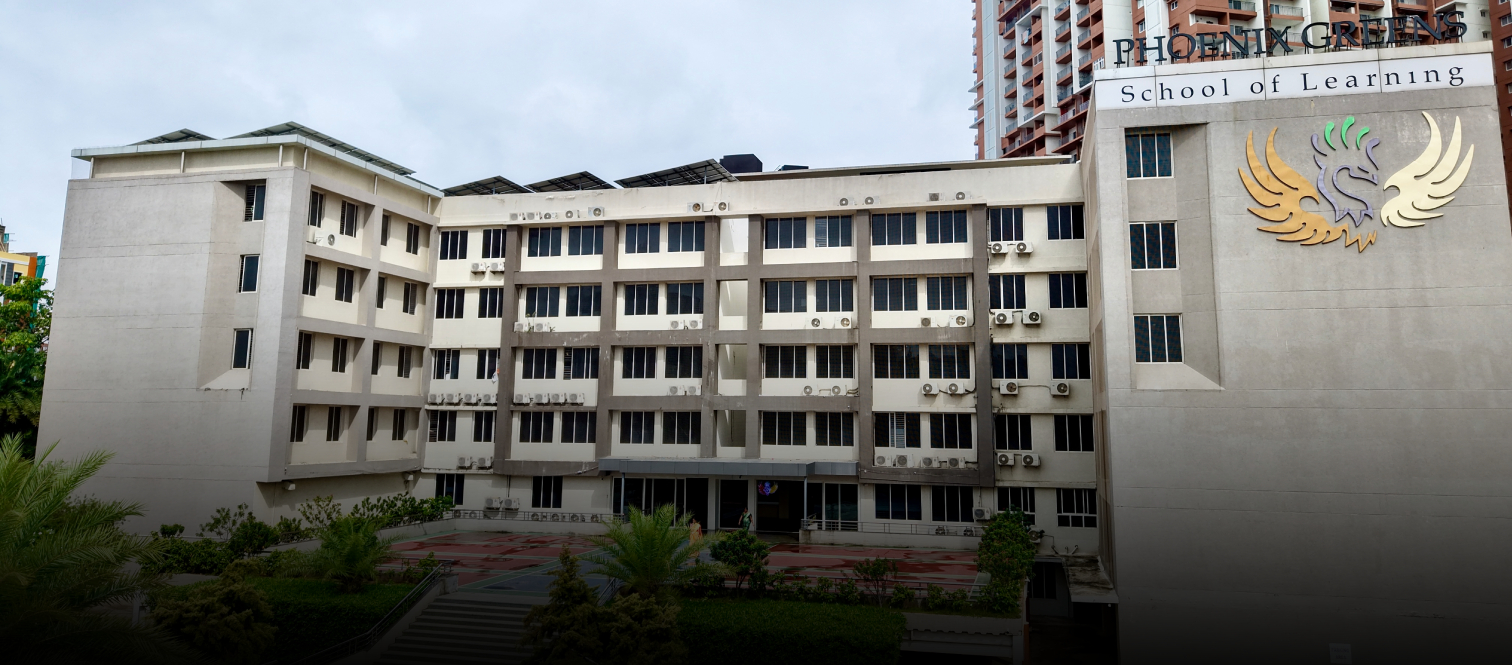
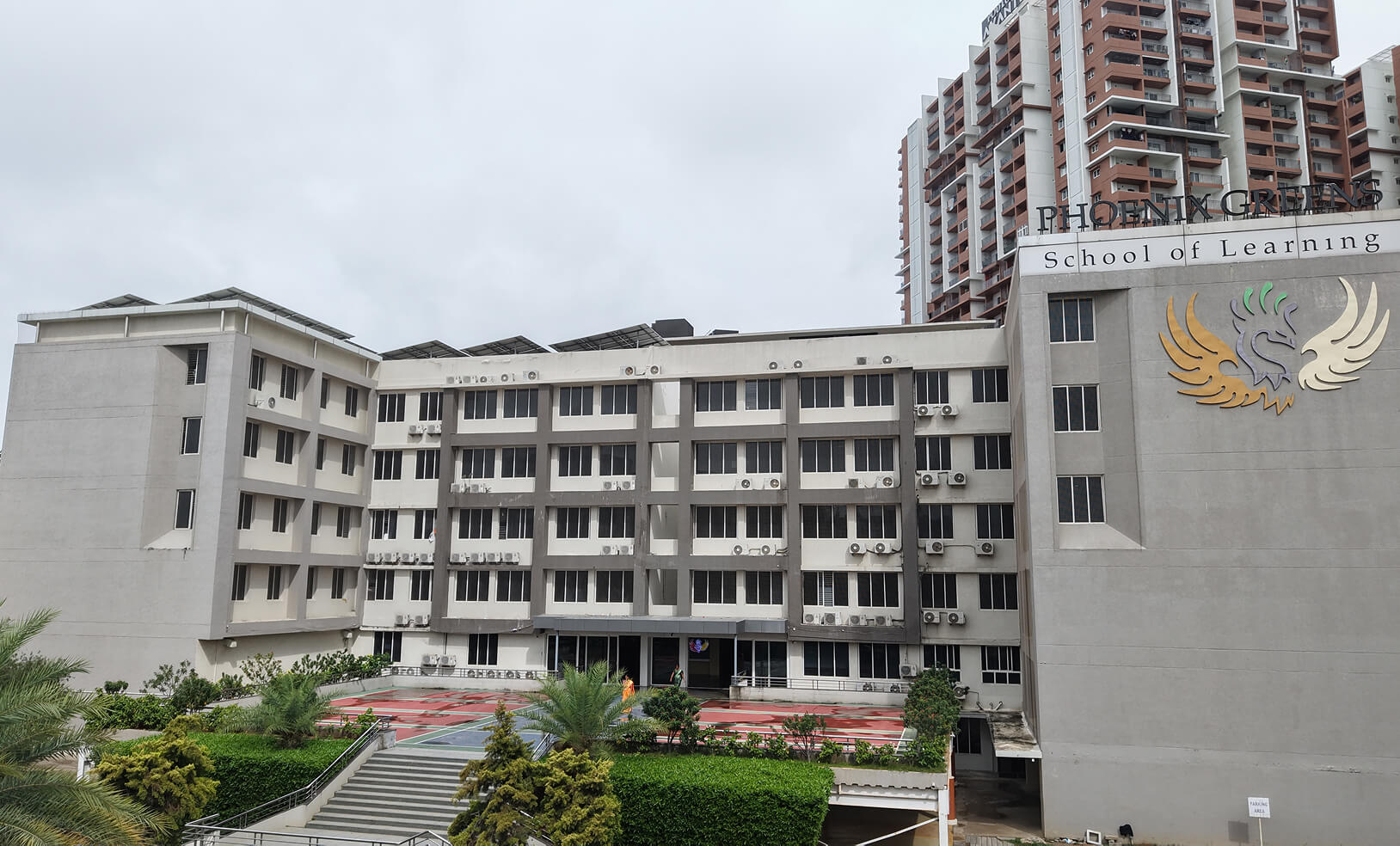
Phoenix Greens School of Learning is one of Hyderabad’s most respected Cambridge-affiliated schools, offering the full Cambridge pathway alongside the CBSE curriculum. Our Cambridge programme is not simply a replication of an international framework — it is a genuinely enriched, locally contextualised experience that combines global standards with Hyderabad’s unique intellectual and cultural environment.
What makes Phoenix Greens’ Cambridge programme distinctive:
- Expert Cambridge-trained faculty who understand the curriculum’s inquiry-based philosophy and bring it to life in every classroom
- Dedicated science laboratories with full practical facilities, ensuring students experience hands-on Cambridge Science assessments with confidence
- A 5-acre future-ready campus at Kokapet featuring smart classrooms with interactive panels, a 100-seater AV room, a computer lab with 45 active systems, and a well-stocked library
- Global Perspectives integration that connects the Cambridge syllabus to real-world issues relevant to both Hyderabad and the wider world
- Strong pastoral support that ensures every student navigates the Cambridge journey with guidance, not just instruction
- An exceptional track record, with our alumni earning places at top universities including BITS Pilani, Manipal, Christ College Bangalore, the University of Texas at Dallas, and Shiv Nadar University
Cambridge vs. CBSE — Which Is Right for Your Child?
Both Cambridge and CBSE are outstanding curricula that produce excellent students. The right choice depends entirely on your child’s personality, learning style, and future goals.
Factor | Cambridge (CAIE) | CBSE |
Global Recognition | International — 160+ countries | National — India |
Teaching Style | Inquiry, analysis, independent study | Concept-based, structured |
Assessment | Mixed (exams, coursework, practicals) | Primarily annual board exams |
Ideal for | International university aspirations | JEE, NEET, CUET, Indian universities |
Subject Flexibility | High — cross-stream combinations | Moderate — structured streams |
Grading | A* to G (IGCSE); A* to E (A Level) | Percentage-based |
Best fits | Curious, self-directed learners | Disciplined, exam-focused learners |
Phoenix Greens offers both pathways under one roof, so your child’s future is never limited by a single choice made at age five.
Cambridge vs. CBSE — Which Is Right for Your Child?
Both Cambridge and CBSE are outstanding curricula that produce excellent students. The right choice depends entirely on your child’s personality, learning style, and future goals.
Factor | Cambridge (CAIE) | CBSE |
Global Recognition | International — 160+ countries | National — India |
Teaching Style | Inquiry, analysis, independent study | Concept-based, structured |
Assessment | Mixed (exams, coursework, practicals) | Primarily annual board exams |
Ideal for | International university aspirations | JEE, NEET, CUET, Indian universities |
Subject Flexibility | High — cross-stream combinations | Moderate — structured streams |
Grading | A* to G (IGCSE); A* to E (A Level) | Percentage-based |
Best fits | Curious, self-directed learners | Disciplined, exam-focused learners |
Phoenix Greens offers both pathways under one roof, so your child’s future is never limited by a single choice made at age five.
Frequently Asked Questions
Q1. At what age can my child start the Cambridge curriculum at Phoenix Greens? The Cambridge journey at Phoenix Greens begins from Pre-Primary (Nursery) onwards. Early years education at our school lays a solid foundation aligned with Cambridge’s philosophy of play-based, inquiry-led learning.
Q2. How many subjects does my child study for IGCSE? Most students study between 6 and 9 subjects at IGCSE. Phoenix Greens will help your child select a balanced combination that reflects their academic strengths and future aspirations, while ensuring they meet university entry requirements.
Q3. Is the Cambridge curriculum recognised for admission to Indian universities? Yes. Cambridge IGCSE and A Level results are accepted by several Indian universities, including institutions under Delhi University, BITS Pilani, Manipal University, and many private universities. Students with strong A Level grades in relevant subjects are generally well-positioned for both Indian and international admissions.
Q4. Is the Cambridge syllabus harder than CBSE? Cambridge and CBSE are different in approach rather than simply harder or easier. Cambridge places greater emphasis on application, analysis, and independent thinking. CBSE focuses more on structured conceptual mastery and performs excellently at feeding into Indian competitive examinations. At Phoenix Greens, our teachers are trained to bring out the best in students under both systems.
Q5. Can a student switch from CBSE to Cambridge (or vice versa)? In most cases, transitions are possible in the earlier years (up to Grade 6 or 7) with appropriate bridging support. From Grade 8 onwards, a switch becomes more complex. Phoenix Greens offers counselling to families considering a transition, and our team will guide you honestly about what is in your child’s best interest.
Q6. What universities do Phoenix Greens Cambridge students go to? Our Cambridge alumni have gone on to study at BITS Pilani (Goa), Manipal Institute of Technology, Christ College Bangalore, Shiv Nadar University Delhi, the University of Texas at Dallas, and Mahindra University, among others.
Q7. How can I apply for Cambridge admissions at Phoenix Greens? Visit www.phoenixgreens.com/admissions or call us at +91 91343 11111. Admissions for the 2026–27 academic year are currently open, and our counselling team will walk you through every step of the process.
Conclusion: The Cambridge Syllabus Is a Global Launchpad — Choose Where Your Child Takes Off From
The Cambridge curriculum is more than a set of subjects and examinations. It is a complete educational philosophy — one that shapes how students think, ask questions, solve problems, and engage with the world. Students who go through the Cambridge pathway emerge not just with internationally recognised qualifications, but with the intellectual maturity and academic confidence that the best universities and employers in the world are looking for.
If your child is curious, ambitious, and you have global horizons in mind for them, the Cambridge pathway at Phoenix Greens is worth a very close look.
Admissions for 2026–27 are open. Enquire Now →
Phoenix Greens School of Learning is located at Kokapet Grampanchayath Road, beside Krishna Goshala, near Tempus Apartments, Kokapet, Rajendra Nagar Mandal, Hyderabad, Telangana – 500075. Contact: +91 91343 11111 | frontdesk@phoenixgreens.com