
CBSE or Cambridge – The Question Every Hyderabad Parent Wrestles With
CBSE or Cambridge - The Question Every Hyderabad Parent Wrestles With
Every admission season, there’s a conversation that happens dozens of times in our counselling room. A parent sits across from our admissions team, leans forward a little, and asks some version of the same question: “We’ve been thinking about this for months. CBSE or Cambridge – honestly, what’s better?”
Honestly? It depends on your child. But that’s not the whole answer, and parents deserve more than a diplomatic non-answer. After years of running both curricula on the same campus, watching the same children grow through them, and talking with parents who’ve made both choices – and sometimes switched between them – we’ve accumulated a perspective that’s harder to find than a comparison table.
This article is that perspective. Not a brochure. Not a sales pitch for either board. Just an honest attempt to help you think through one of the more consequential decisions you’ll make for your child.
The framing most parents get wrong
When parents compare CBSE and Cambridge, they almost always focus on the boards – the examining body, the certification, the global recognition. That’s understandable. But the more useful question is about what daily learning actually feels like under each system. Because your child isn’t going to experience “CBSE” as an abstract concept – they’re going to experience a Wednesday afternoon in a classroom. They’re going to experience how their teacher responds when they give a wrong answer. They’re going to experience whether asking “why?” is encouraged or quietly discouraged.
That’s the real comparison. And it looks quite different depending on the child.
What CBSE actually means, inside a classroom
CBSE – the Central Board of Secondary Education – is India’s national curriculum. Over 24,000 schools follow it. Its textbooks (NCERT) are the same in Hyderabad as they are in Delhi, Pune, or Kochi, which matters enormously for families who move around.
The curriculum is structured in the best sense of that word. There’s a clear, well-sequenced syllabus. Children know what they’re expected to learn, and teachers know exactly what they’re working towards. For a lot of children, this is genuinely the right environment – they thrive when the path is clearly laid out, when effort in the right direction is rewarded, when they can see measurable progress.
The criticism most often levelled at CBSE – that it’s “rote learning” – is increasingly outdated. The board has been quietly but meaningfully reforming itself over the past several years. Competency-based questions have replaced straightforward recall in board exams. Application and analysis matter more than they did a decade ago. The CBSE that today’s Grade 10 students will face is genuinely different from the one their parents remember.
Where CBSE remains unmatched, though, is in its alignment with Indian competitive exams. JEE, NEET, UPSC – the syllabi for all of them trace back directly to NCERT. A CBSE student who studies sincerely doesn’t need to “prepare separately” for these exams in the way a Cambridge student would. The curriculum itself is the preparation.
What Cambridge actually means, inside a classroom
Cambridge’s formal name is CAIE – Cambridge Assessment International Education, administered by the University of Cambridge. At Phoenix Greens, we offer the Cambridge programme for Grades 1 through 9.
What makes the experience genuinely different for young learners is the nature of the questions children are asked. In a CBSE classroom, a teacher might ask: “What is photosynthesis?” In a Cambridge classroom, the starting point is more likely: “If you put a plant in a dark room for two weeks, what do you think happens to it – and why?” Same science, completely different entry point.
This matters because the two questions do different things to a child’s mind. The first invites retrieval. The second invites thinking. Neither is inherently superior – retrieval is a legitimate and important cognitive skill – but they develop different muscles. Cambridge students tend to emerge from their early years more comfortable with ambiguity, more willing to form and defend an opinion, more practised at connecting ideas across subjects. CBSE students tend to have stronger subject-specific foundations and are better prepared for the kind of structured, high-volume exam pressure they’ll encounter in Indian competitive preparation.
Cambridge also distributes its assessment across the year rather than concentrating everything into a single high-stakes exam. Projects, practicals, coursework – the grade you earn reflects a body of work rather than one afternoon’s performance. For children who are strong thinkers but poor exam performers, this can be transformative. For children who rise to the occasion under pressure, the CBSE model might actually suit them better.
A story that tells you more than any comparison chart
One of the reviews that stays with our admissions team came from a parent who moved their child to Phoenix Greens post-COVID – shifting from Cambridge to CBSE at Grade 7:
“Our shift to Phoenix Greens school immediately post COVID was the most welcoming and beneficial change for our child, who made a shift from Cambridge to CBSE curriculum into Grade 7. The major reason for our shift was to have our child be able to experience other activities too along with academics – and that was exactly catered to and met here at Phoenix Greens, which not only made our child fall in love with the learning process here, but also make a whole new bunch of friends.”
What’s interesting about this isn’t the switch itself – it’s the reason. This parent wasn’t dissatisfied with Cambridge as a curriculum. They wanted a different balance: more breadth, more co-curricular life alongside academics. The curriculum choice, in other words, was inseparable from the school choice. That’s often how it is in practice.
The case no one talks about: starting Cambridge, finishing CBSE
Here’s something we’ve observed over many years that doesn’t appear in most “CBSE vs Cambridge” articles: the two-phase approach works remarkably well for a lot of children.
Cambridge’s primary years are exceptionally good at one thing – building a child’s relationship with learning itself. The inquiry approach, the emphasis on communication, the comfort with open-ended problems – these are habits of mind that once formed, don’t disappear when a child transitions to a different curriculum. A child who has spent Grades 1 through 5 learning to ask good questions and investigate them brings that quality into a CBSE classroom from Grade 6 onwards.
Principal Anju Sharma speaks about this often. In her own words:
“Our curriculum emphasises values. Not just attitudes like sharing or caring, but also a curiosity for learning.”
That curiosity, once it’s been genuinely cultivated in the early years, tends to persist. We see it in our CBSE toppers – several of the students who scored 99% and 98.8% in recent Grade 10 board exams spent their formative years on the Cambridge pathway before transitioning. That’s not a coincidence, in our view. Not conclusive evidence either. But a pattern worth knowing about.
The career question - and why it's more complicated than it looks
The conventional wisdom runs like this: CBSE is for children who’ll study in India; Cambridge is for children who’ll go abroad. This is broadly true, and broadly incomplete.
It’s true that Cambridge IGCSE and A Level qualifications are recognised directly by universities in the UK, USA, Canada, Singapore, and Australia. The standardised grading – A* through G – is understood by admissions offices worldwide without any translation required. For a family with genuine international ambitions, Cambridge removes friction from that process.
It’s also true that CBSE is the most sensible pathway for JEE and NEET aspirants. The NCERT syllabus that CBSE students cover is essentially the JEE and NEET syllabus. Asking a Cambridge student to sit these exams without additional preparation is asking them to compete having played a different sport in training.
Where the conventional wisdom gets incomplete: increasingly, Indian universities accept Cambridge qualifications through the AIU equivalency framework. And increasingly, international universities – particularly in the US – evaluate Indian students holistically enough that a strong CBSE profile with stellar test scores isn’t a disadvantage. The walls between these two paths are lower than they were fifteen years ago.
The cleaner question is probably this: where does your child’s curiosity point? A child obsessed with biology who’s already talking about medicine – CBSE, without question, and start thinking about NEET coaching early. A child who reads voraciously across subjects, who asks questions that don’t have simple answers, who might end up studying philosophy or architecture or global business somewhere in Europe – Cambridge, and give them the conceptual wingspan to figure out what they actually love.
Most children, at age four or five, are neither of these. Which is exactly why the two-phase approach often makes sense.
The fee reality - said plainly
Cambridge costs more than CBSE. This is true almost universally. The reasons are real: Cambridge affiliation fees, teacher certification programmes, curriculum materials, and examination entry fees at the IGCSE stage – all of these create a higher cost structure.
We’re not going to dress it up as simply “an investment.” It is an investment, and families should make it with clear eyes. The right question isn’t “is Cambridge worth it in the abstract?” but “is Cambridge worth it for this specific child, given our family’s plans and priorities?”
For a family where international education is a genuine possibility and the child’s learning profile suits inquiry-based work – yes, the premium is usually justified. For a family prioritising competitive exam preparation in India, spending more on Cambridge and then spending again on NCERT bridging coaching is probably not the best allocation of resources. For specific fee details at Phoenix Greens, please speak with our admissions team – we’d rather walk you through it in person than quote numbers without context.
A simple framework for making this decision
We’ve seen enough families navigate this choice to know what the genuinely useful questions are. Not “which board is better?” – but these:
How does your child learn? Do they thrive with clear structure and defined goals, or do they light up when given an open problem and time to explore it? If you’re not sure, the Cambridge primary years are a gentle, lower-stakes space to find out. What’s the most likely higher education path? This question gets more answerable as children get older. For early primary admissions, most families honestly don’t know yet – and that’s fine. For a Grade 8 lateral admission, the answer starts to matter more. What does the school actually do with the curriculum? Two CBSE schools can produce completely different educational experiences. What matters isn’t just board affiliation – it’s what teachers do inside that framework. Visit the classroom. Ask about a typical Tuesday. Are you likely to move? CBSE’s national standardisation makes transfers across cities far smoother – worth weighing if relocation is plausible. |
What Phoenix Greens actually offers, and what it doesn't
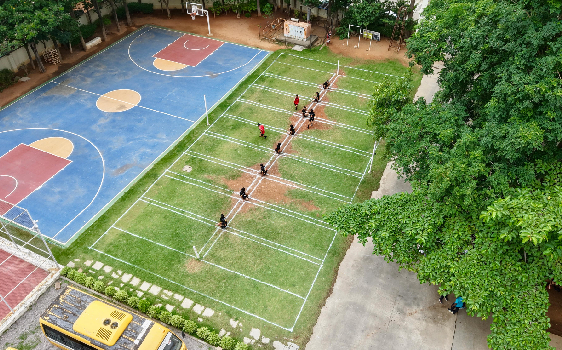
We offer both CBSE (Grades 1 through 12) and Cambridge (Grades 1 through 9) on the same campus in Kokapet. Our student-teacher ratio sits at 10:1, which is among the most favourable in this part of Hyderabad. The same sports facilities, the same 100-seat AV room, the same computer lab, the same teachers across shared activities – Cambridge and CBSE students aren’t separated into different worlds here. They grow up alongside each other.
What this means practically: a child who begins on Cambridge and transitions to CBSE at Grade 6 or 7 doesn’t experience that transition as moving to a different school. The campus, the community, the culture – it’s continuous. That matters more than it might seem when you’re asking a 12-year-old to navigate a curriculum change.
We don’t claim to be right for every child or every family. Some children genuinely need the environment of a school with a deeper competitive exam focus, and we’d say so honestly rather than promise something we don’t deliver. What we do deliver is a genuinely integrated environment where both pathways are taken seriously – not one where Cambridge is a premium add-on and CBSE is the real school.
Our Grade 10 results speak to that. A 100% pass rate, with students scoring 99%, 98.8%, and 98.4% – several of them having come through our Cambridge primary years. That’s the number we’re most proud of, because it’s the number that tells you what actually happens at the end of the journey.
Phoenix Greens has been recognised as a Top 20 CBSE school and awarded “Trailblazing School of the Year” for innovative and sustainable education practices. The school holds the top position in the West Zone for both online learning and curricular innovation. |
If you're still deciding
Come and see the school. Not a virtual tour – though we offer those – but actually walk through the campus, sit in on a class if we can arrange it, and talk to our team. Principal Anju Sharma has spent her career building an institution around the belief that doing the right thing at the right time is what education is actually about. That’s not a marketing line. It’s a genuine orientation towards individual children and their individual moments of readiness.
Admissions for 2027-28 are open across both boards, from Nursery to Grade 12. We’re on the Kokapet Grampanchayath Road near Krishna Goshala, not far from the Outer Ring Road – and we’re easy to reach from Gachibowli, the Financial District, Narsingi, and Nanakramguda.
The conversation our counsellors have had hundreds of times is one they’re genuinely glad to have with you.
Admissions open for 2027-28 Both CBSE and Cambridge pathways available from Nursery to Grade 12. +91-8121551888 · info@phoenixgreens.com · phoenixgreens.com/admissions/ |
Frequently asked questions
What is the main difference between CBSE and Cambridge?
CBSE follows a structured national syllabus aligned with Indian competitive exams like JEE and NEET. Cambridge emphasises inquiry-based learning, continuous assessment, and skills recognised by universities worldwide. The daily learning experience feels quite different – CBSE is more teacher-directed, Cambridge more student-led.
Which board is better for JEE and NEET preparation?
CBSE is the more natural preparation pathway for both exams. The JEE and NEET syllabi map directly to NCERT content, which CBSE students cover as their core curriculum. Cambridge students can sit these exams but typically need additional bridging preparation.
Is Cambridge recognised by Indian universities?
Yes. Cambridge IGCSE and A Level qualifications are recognised by the Association of Indian Universities (AIU). Most Indian universities accept them for undergraduate admission, though specific requirements vary by institution and course.
Can my child switch from Cambridge to CBSE midway?
Yes, and it happens more often than most parents expect. At Phoenix Greens, children who transition from Cambridge to CBSE – typically at Grade 6 or 7 – generally find the adjustment manageable, particularly because the inquiry skills and reading habits built during Cambridge primary years translate well into the CBSE environment.
Does Phoenix Greens offer both CBSE and Cambridge?
Yes. Phoenix Greens School of Learning in Kokapet, Hyderabad, runs both CBSE (Grades 1-12) and Cambridge (Grades 1-9) on the same 5-acre campus. Families can choose either pathway, or begin on Cambridge and transition to CBSE in secondary school.
Which board is less stressful for a child?
This depends more on the individual child than on the board. Cambridge’s continuous assessment model distributes pressure across the year – some children find this a relief, others find the sustained project demands more tiring. CBSE’s structured approach suits children who prepare well and perform confidently under exam pressure. There’s no universally easier option.
How do I apply for admissions at Phoenix Greens?
Visit phoenixgreens.com/admissions/, call +91-8121551888, or email info@phoenixgreens.com. Our admissions team will guide you through a counselling session, school visit, and the application process at your own pace.
Phoenix Greens School of Learning · Survey No 122, Kokapet Village, Rajendra Nagar Mandal, Hyderabad 500075 · phoenixgreens.com · Last reviewed: June 2026